No recent cultural trend has produced quite as much defensive energy from women who identify as feminists as the tradwife aesthetic — and I say this as someone with a degree in Sociology, who spent years working on women's equality projects, and who considers herself deeply invested in feminist issues. The gender pay gap produces outrage. The erosion of parental leave produces exhaustion. But a woman who bakes bread on camera and calls herself a traditional wife produces something more visceral and considerably less examined: the urge to explain to her why she is wrong about her own life. Publications like The New York Times and The Cut have run piece after piece framing the tradwife trend as dangerous, regressive, a rollback of everything women have fought for. I want to push back on that framing, not because I think the tradwife aesthetic is above criticism, but because I think the criticism being leveled says more about its authors than about the women they are writing about, and that distinction matters if we are serious about what feminism is actually supposed to be doing.
Tradwife Ideology vs. Tradwife Lifestyle: What Are We Actually Criticizing?
There is a version of the tradwife trend that deserves scrutiny, and it tends not to be the version that gets it. The explicitly ideological wing of this content — the women arguing that female submission is divinely ordained, that feminism is the root cause of women's unhappiness, that a good marriage requires a woman to subordinate her judgment entirely to her husband's — is making empirically weak claims with real consequences for women who absorb them without the financial safety net to make domestic dependence a genuine choice rather than a structural trap. That argument deserves to be engaged with seriously, and the engagement is not difficult to sustain on the evidence: the research on financial vulnerability in domestically dependent women, on the outcomes for women who exit professional life and subsequently divorce, on the gap between the tradwife content's presentation of domestic harmony and the economic realities that underpin it, all of that is available and all of it should be part of the conversation.
But that is a small and specific subset of what gets filed under the tradwife label in most mainstream coverage. The broader category includes women who have simply chosen to leave paid work, to prioritize their households and their children, to build a life organized around domestic rather than professional achievement, and who happen to document that life online. When a publication runs a piece on the tradwife trend as a cultural threat, it is not drawing a careful line between the ideology and the lifestyle. It is treating the decision to be a stay-at-home woman as the problem, full stop, and using the more explicitly regressive content as cover for that position. That conflation is sloppy analysis, and it carries a cost that I do not think its authors have carefully considered.
Because what it means, functionally, is that a significant portion of the feminist media's objection to tradwives is not an objection to the ideas those women are spreading. It is an objection to the life those women are living. And that is a very different argument, one that the feminist project is not in a strong position to make.
The Double Standard That Nobody Wants to Sit With
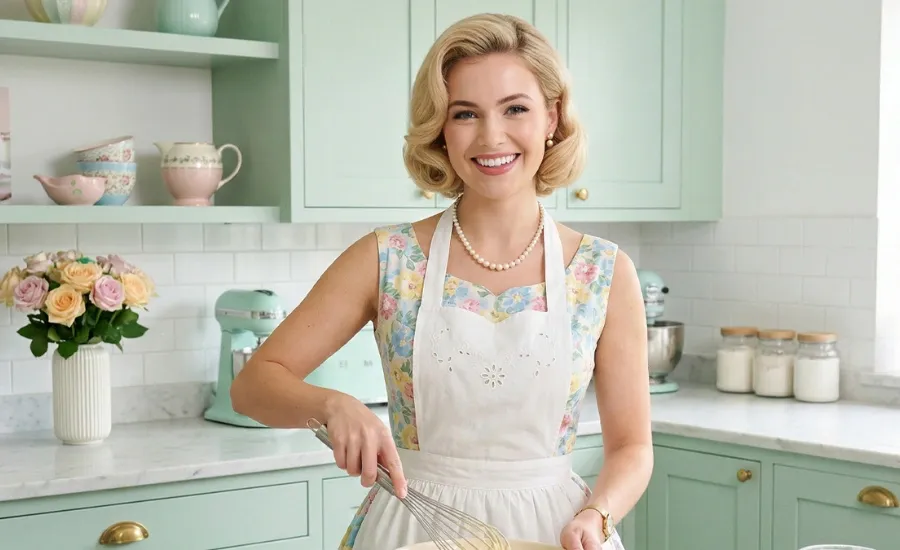
Let me put a specific question on the table, because I have been waiting for someone in the mainstream coverage to address it directly, and nobody has managed to do so convincingly. When a man leaves a high-pressure career to spend time raising his children, the cultural response is warm. He is praised for his priorities. Think pieces are written about his courage in defying masculine norms. He is held up as evidence that men are evolving, that the culture is changing, that something is getting better. His choice is read as both radical and admirable. When a woman makes the structurally identical decision, that is, to exit professional life to prioritize her home and her family, she becomes a subject of concern. Her choice is framed as a symptom, a capitulation, evidence of something having gone wrong, either in her specifically or in the culture that produced her.
I want to be precise about what I am pointing at here, because the response I usually get to this observation is that the two situations are not structurally identical, that when a man stays home, he is moving against the grain of expectations that were never fair to begin with, while when a woman stays home, she is moving with a current that has historically carried women toward subordination and economic vulnerability. That argument has some weight, and I am not dismissing it. What I am saying is that it does not resolve the inconsistency. It explains the inconsistency, but explaining why a double standard exists is not the same as defending it. The feminist project has never been comfortable with double standards applied to women, so it should be equally uncomfortable with double standards applied on women's behalf.
The woman who leaves her career to raise her children is being told, with remarkable consistency across mainstream feminist media, that her choice is suspect in ways that the equivalent man's choice is not. She is being asked to carry the weight of a structural critique that he is not being asked to carry. Her individual decision is being read as a political statement in a way that his is not. And if you ask whether that asymmetry is fair — whether it is consistent with the feminist principle that women's choices about their own lives should be treated as the choices of autonomous adults rather than data points in a political argument — the honest answer is that it is not.
False Consciousness: The Marxist Concept Feminism Uses to Silence Choice
The concept that does the most work in the feminist critique of tradwives, even when it is not named directly, is false consciousness; the Marxist idea, adapted into feminist theory particularly through the work of second-wave thinkers, that women under patriarchy cannot reliably know their own interests because their preferences have been shaped by the system that oppresses them. It is a genuinely important theoretical tool. It explains real phenomena. The internalization of beauty standards that cause harm, the normalization of unequal domestic labor, and the ways in which women learn to frame their own constraint as preference — false consciousness, as a concept, captures something true about how ideology works on the people it affects.
The problem is what happens when it gets deployed not as a structural analysis but as a silencing mechanism. When an educated woman with full information about the feminist critique of domestic dependence looks at her options and decides that, for her, at this point in her life, stepping back from professional work is what she wants, and the response is that she does not really know what she wants because patriarchy has distorted her preferences, you have stopped using false consciousness as an analytical tool and started using it as a way to dismiss any woman whose choices you find inconvenient. The theory has become unfalsifiable. Any woman who agrees with the feminist prescription is making an authentic choice; any woman who does not is demonstrating the extent of her conditioning. This is not rigorous thinking. It is a closed loop that immunizes itself against evidence.
Sociology has a name for this move as well: it is the No True Scotsman fallacy applied to women's liberation. The liberated woman is defined as the woman who makes the choices feminism endorses, which means every woman who makes different choices is, by definition, not fully liberated, which means her choices do not need to be taken seriously on their own terms. This is circular, and it is condescending, and it is doing real damage to the credibility of feminist arguments at a moment when those arguments need to be as strong as possible.
The Burnout Factor: Why the Tradwife Fantasy Is Really About Rest
Let me turn to what I think is actually driving the tradwife trend's cultural traction, because this is the part that the mainstream coverage gets most consistently wrong, and getting it wrong has consequences beyond the tradwife debate specifically.
The feminist project successfully opened professional doors that were previously closed to women. This is a genuine and significant achievement, and I am not minimizing it. What it did not do — what it has not done, despite decades of effort and significant cultural progress on the question in principle — is redistribute the domestic labor that women were already carrying before those doors opened. The result, for the generation of women now in their thirties and forties, was not equality in any meaningful sense of the word. It was an addition. Women entered professional life on the same terms as men, which required performing at the same level and investing at the same intensity, while the expectation of domestic management remained substantially in place, particularly after children. The mental load research that has been accumulating for twenty years across multiple countries and professional contexts says the same thing in different ways: women in dual-income professional households still carry a disproportionate share of domestic and childcare responsibility, the gap widens significantly after the birth of a first child, it persists across income levels and educational backgrounds, and it has closed far more slowly than the professional gap it was supposed to accompany.
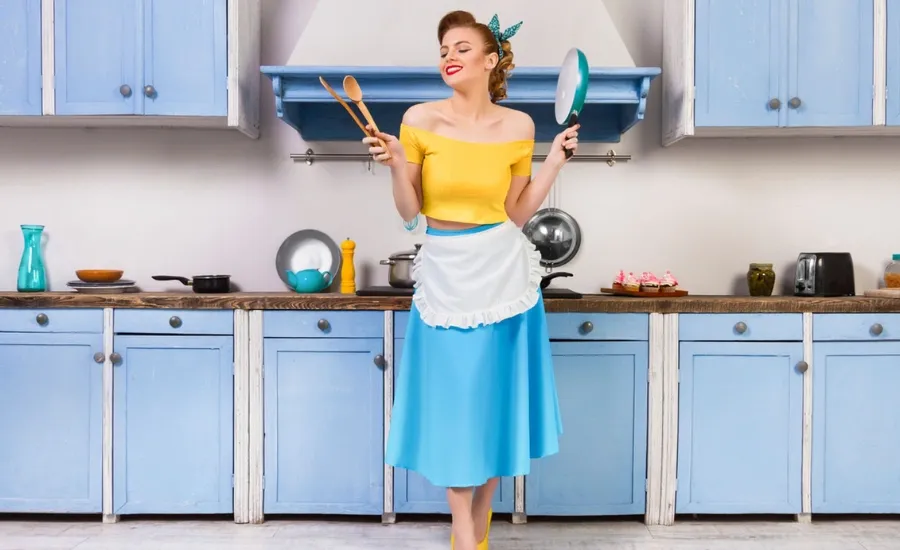
The phrase having it all turned out, in practice, to mean doing it all. Two full-time jobs: one paid, one not. The paid one with performance reviews, promotion tracks, and the daily requirement of being visibly competent. The unpaid one with no recognition, no boundaries, and the additional cognitive weight of being the person who notices what needs to be done before anyone else has registered that it needs doing. The tradwife fantasy did not create the exhaustion that sits underneath this arrangement. It found the exhaustion, gave it soft lighting and a linen apron, and offered it a narrative about a different life. The women who find that offer momentarily appealing are not failing to understand their situation. They are understanding it very well. The fantasy is not about submission. It is about rest.
The correct feminist response to this is not to pathologize the fantasy. It is to ask why the conditions exist that made the fantasy necessary, to ask why workplace equality was treated as the finish line when it was at most the halfway point, why the domestic labor question was so consistently deferred, why the feminist project celebrated women entering the workforce without mounting an equivalent campaign to transform what awaited them when they got home. Those are uncomfortable questions because they implicate not just patriarchy in the abstract but the specific choices made by the feminist movement about where to put its energy, and movements are not always eager for that kind of self-examination. But they are the right questions, and the tradwife trend is forcing them into the open, whether the mainstream coverage acknowledges it or not.
The Consistency Problem: Has Liberal Feminism Become About Compliance?
I want to be direct about something that I think the publications running concerned tradwife coverage are avoiding, because naming it clearly seems necessary at this point. The liberal feminism that dominates the mainstream media, the feminism of The Cut, of certain corners of The New York Times, of the professional-class women's media that has significant cultural influence, has a specific vision of what a good woman's life looks like. It involves professional achievement, financial independence, a relationship of equals, and a domestic arrangement negotiated consciously rather than inherited. These are reasonable things to value. I value most of them myself. The problem is when that vision stops being one option among many and becomes the standard against which all women's lives are measured — when feminism stops being a framework for expanding women's freedom and becomes a framework for policing which freedoms women are permitted to exercise.
The tradwife debate is where this tension becomes impossible to ignore, because the tradwife represents a woman who has looked at the dominant feminist vision of the good life and decided, for whatever combination of reasons, that it is not hers. She may be wrong. Her reasons may be shaped by ideology in ways she has not fully examined. The economic risks of her choice may be ones she is underestimating. All of that may be true and still not justify treating her as a problem to be solved rather than a person who made a decision. The moment feminism decides that some women's choices require feminist intervention while others do not — that the career woman's choices are hers to make but the stay-at-home woman's choices are symptoms — it has stopped being a project about freedom and become a project about compliance.
This is not a comfortable thing to say, and I am aware that it will be read by some people as an argument against feminism or in favor of the tradwife ideology. It is neither. It is an argument that the feminist project is most powerful when it is most consistent and when its commitment to women's agency is not conditional on the content of the choices that agency produces. The tradwife trend is a stress test of that consistency, and the mainstream coverage is, by and large, failing it.
Beyond the Backlash: What a Truly Honest Conversation Requires
The conversation that the tradwife trend is demanding, and that the mainstream coverage is consistently refusing to have, requires several things simultaneously. It requires distinguishing clearly between the ideology — the claim that female submission is natural or divinely sanctioned, that feminism made women unhappy, that the solution to women's professional exhaustion is to hand the decision-making to a man — and the lifestyle, which is simply a woman organizing her life around her home rather than her career. These are separable, and treating them as the same thing is an analytical failure that undermines every specific criticism that follows.
It requires engaging honestly with what the burnout data says about why the fantasy has traction rather than treating every woman who finds it appealing as evidence of false consciousness. The exhaustion is real, the conditions that produced it are structurally documented, and a feminism that responds to that exhaustion with cultural disapproval rather than structural analysis has lost the plot.
And it requires sitting with the question of the double standard without deflecting from it. If we celebrate the man who steps back from professional life to prioritize his family, we need to be able to articulate, clearly and consistently, why the same celebration does not extend to the woman who makes the same choice, or we need to acknowledge that we cannot, and that the asymmetry reflects something about our assumptions that requires examination rather than defense.
Feminism has always been, at its most rigorous, an argument about the conditions under which choices are made rather than a prescription for which choices to make. The tradwife debate is an opportunity to return to that rigor. The question worth asking is not whether these women are making the right choice. It is whether the conditions exist, economically, structurally, culturally, under which any choice they make can actually be free. Until that question is answered with something better than alarm and cultural disapproval, the panic about tradwives is not protecting women. It is just deciding, once again, which version of a woman's life is acceptable, and calling that feminism.