

The version of burnout everyone talks about is visible. You stop showing up. You cry in the bathroom. You hand in your resignation after a particularly bad Monday. That version gets diagnosed, treated, and turned into content. The version spreading in 2026 does not look like collapse; it looks like a woman who is on top of everything, responds to emails before 7 AM, never misses a deadline, and has not taken an unscheduled afternoon off in two years. If you are reading this and your first thought was 'that sounds like me, but I'm fine' — that is exactly the problem.
Your Brain on Chronic Low-Grade Stress Is Not a Productivity Machine
The clinical mechanism behind quiet burnout is not fatigue — it is the accumulation of allostatic load. Allostatic load refers to the cumulative wear on the body and nervous system from sustained stress responses, and research from McEwen and Stellar (1993) established that the damage occurs not at the point of acute crisis, but during prolonged, moderate activation of stress systems.
In practical terms: your body does not distinguish between 'I am outrunning a threat' and 'I have seventeen open tabs and a performance review on Thursday.' Cortisol rises in both scenarios. The difference is that the second scenario rarely resolves, which means cortisol does not drop back to baseline. Over months, this sustained elevation begins to impair the very functions you are relying on to manage it — executive function, working memory, emotional regulation, and decision quality.
What this looks like in practice: you are completing tasks, but the quality of your thinking has flattened. You are executing, not creating. You are managing, not leading. The output looks fine to everyone else, and possibly to you as well. The deterioration is happening at the level of cognitive capacity, not task completion.
This distinction matters because the standard productivity metrics you use to assess yourself — inbox management, deliverables hit, deadlines met — will all look fine right up until the point they do not.
The Quiet Burnout Symptoms in 2026 That Get Reframed as Professionalism
The reason quiet burnout symptoms in 2026 are being under-identified is structural. The behaviours it produces are culturally rewarded, particularly in professional environments that prize reliability, consistency, and availability. This is not a criticism of ambition, it is a description of a diagnostic problem.
Below is what quiet burnout actually looks like in a high-functioning professional context:
Emotional blunting at work: you are not distressed, you are detached. You do not care whether the project lands well. You do not feel the usual satisfaction when something goes right. This is not perspective; this is a measurable reduction in dopaminergic reward sensitivity associated with prolonged cortisol exposure.
Narrowing of discretionary effort: you do what is required and nothing beyond it. This feels like 'setting limits' but is functionally different because true boundary-setting is a deliberate choice; this is depletion masquerading as a policy.
Irritability and low activation for previously enjoyable activities: not just work activities. The weekend does not feel restorative. The hobby you used to do does not get started. According to the World Health Organization's updated occupational burnout criteria (ICD-11), this generalized exhaustion extending beyond work is a key diagnostic indicator.
Increased reliance on systems and structure to compensate: you are adding more to-do lists, more apps, more frameworks. This is the brain trying to offload cognitive labor it no longer processes efficiently. It reads as 'organized.' It is actually a compensatory mechanism.
Sleep that does not recover: you are sleeping the hours, but waking up at the same activation level you went to bed at. Restorative sleep requires a drop in cortisol and an increase in parasympathetic activity — neither of which happens reliably in a chronically stressed nervous system.
None of these are character flaws. They are physiological responses to a demand pattern that has exceeded your system's recovery capacity.
The Three-Variable Audit: How to Assess Your Own Burnout State Without Self-Diagnosis
The following is not a clinical assessment. It is a structured self-observation tool designed to surface patterns that are otherwise easy to rationalize. You need approximately ten minutes and a level of honesty that does not involve managing your own feelings while you do it.
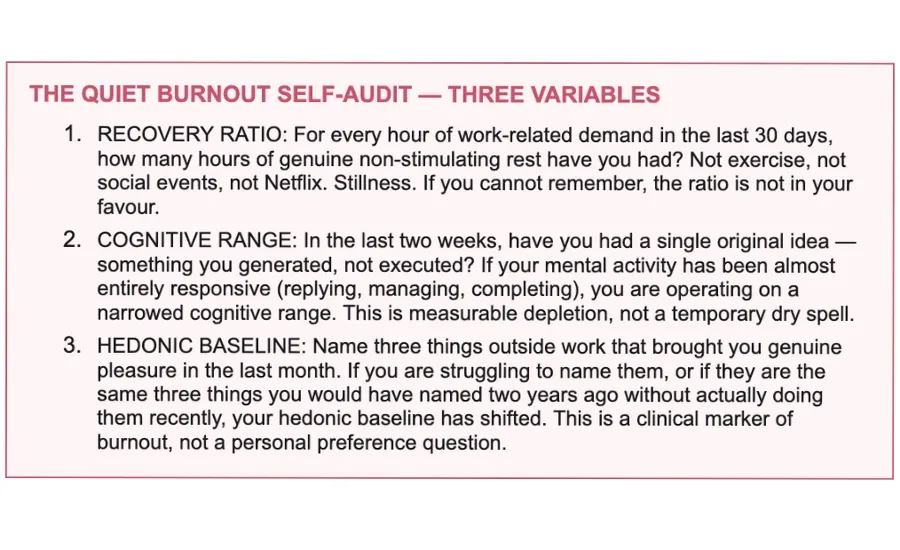
If two or three of these variables are compromised, you are not 'a little tired.' You are in a depletion state that will continue to worsen with each week of unaddressed demand.
The next question is not 'how do I fix this' — it is 'what am I continuing to add to a system that needs subtraction.' This matters because the most common mistake at this stage is attempting to solve burnout through optimisation. More structure, better supplements, improved sleep hygiene — all of which are additions. The evidence-based intervention for allostatic overload is demand reduction followed by recovery, not demand management followed by better coping.
Why the Burnout-as-Badge Culture of 2023 Has Been Replaced by Something More Insidious
Three years ago, burnout was visible enough to be publicly discussed, and that visibility created at least some cultural permission to address it. The current pattern is different. The social framing has shifted from 'I am exhausted' to 'I am consistent' — and consistency, unlike exhaustion, is not something a high-performing woman feels comfortable naming as a problem.
Research published in the Journal of Occupational Health Psychology identified what they termed 'presenteeism under depletion' — the state in which an individual continues to perform while operating with meaningfully degraded cognitive and emotional resources. The study found that this state was not self-correcting. Without structural intervention, the performance gap between actual capacity and apparent output continued to widen until the depletion broke through to visible symptoms.
The 2026 version of this is amplified by remote and hybrid work patterns that have removed the natural circuit-breakers that office environments provided — the commute that served as decompression time, the social frictions that forced cognitive rest, the physical separation between work and recovery space. Many of the women experiencing quiet burnout symptoms in 2026 are doing so in environments with no spatial or temporal boundary between demand and rest.
The practical implication: you cannot rely on feeling bad to tell you when you are in a burnout state. The emotional response to burnout is itself one of the things that gets blunted by it. You need to assess function, not feeling.
What Interrupting Quiet Burnout Actually Requires — and What Does Not Work

This is the section most articles skip because the answer is not useful from a marketing perspective. It does not involve a morning routine, a supplement stack, or a journaling practice. The evidence-based response to burnout involves two things: demand reduction and recovery induction.
Demand reduction means identifying which inputs into your nervous system are discretionary and removing or reducing them. This is not about working less — it is about the non-work demands that are also running on the same resource pool: the social obligations you say yes to out of inertia, the information consumption (news, social media, emails outside work hours) that keeps your activation system switched on, the domestic and logistical decisions that create cognitive overhead without producing recovery.
Recovery induction means deliberately creating conditions for parasympathetic nervous system activation. The research on this (Porges, 2011, Polyvagal Theory) is consistent: the nervous system enters recovery when it registers safety, reduced demand, and social warmth. Practically, this looks like: low-stimulus activities that require no decision-making, extended time in environments associated with rest, and the presence of people with whom you do not have to perform or manage.
What does not work is adding recovery activities to an already full schedule as if they were another task to complete. Booking a yoga class between two calls and adding it to your Notion board is not recovery — it is rebranded productivity. Recovery requires structural space, not better time management.
WHAT TO REDUCE — STARTING THIS WEEK:
Cut all non-essential digital input after 8 PM for 14 consecutive days. Measure cognitive sharpness in the mornings as a proxy variable.
Identify one recurring commitment in the next month that you agreed to from obligation rather than interest. Remove it.
Implement one 20-minute non-stimulating rest period per day — no content consumption, no tasks. This is not meditation unless that is already a zero-effort habit for you. It is simply demand absence.
Do not add any new optimization systems, tools, or routines for 30 days. The experiment is subtraction, not restructuring.
Burnout that looks like productivity is the most expensive kind because it costs you in silence, at full speed, for an extended period before anything surfaces. The three-variable audit above is not a diagnostic — it is a data collection exercise. If the data is telling you something, the relevant response is structural change, not better stress management. You already know how to manage stress. You have been doing it for long enough that it stopped working.
Disclaimer: This article is written for informational purposes only and does not constitute medical or psychological advice. If you are experiencing significant mental health symptoms, please consult a qualified healthcare professional.
Sources referenced: McEwen & Stellar (1993), Allostasis and the Costs of Adaptation; WHO ICD-11 Burnout Classification; Bakker & Costa (2014), Journal of Occupational Health Psychology; Porges (2011), The Polyvagal Theory; Bergland (2013), Psychology Today.