

A few years ago, I watched a colleague walk out of a performance review with a 12% raise and a revised title. She had been in the role for the same amount of time as two other team members who walked out with nothing. They all had the same manager, and they were under the same budget cycle. This outcome had nothing to do with their performance, it was preparation and the willingness to state what she wanted out loud, directly, with evidence.
We talk about workplace inequality in broad structural terms, and those structures are real. But there is also a skill gap that sits entirely within our control: most professional women have never been taught how to negotiate. We rehearse conversations in our heads and abandon them. We frame requests as questions. We apologize before asking. We take the first "no" as a final answer.
Why Strategic Negotiation Feels Riskier for Women (And Why That Perception Is Wrong)
There is a documented phenomenon in organizational psychology called the Social Penalty. Research published in the Journal of Personality and Social Psychology found that women who negotiate assertively for higher compensation are rated as less likeable and less hireable by evaluators of both genders. The same assertive behavior in men produces no such penalty.
This is a real structural dynamic and it explains something that often goes unexamined: many women are not avoiding negotiation because they lack confidence. They are avoiding it because, on some level, they have correctly identified that the social cost of asking may feel higher for them than for their male counterparts.
The strategic response to change how you ask.
The language of effective workplace negotiation for women is not aggressive. It is collaborative, evidence-based, and framed around organizational value rather than personal entitlement. This is not code-switching for the sake of making others comfortable. It is precision. The goal is not to be liked more. The goal is to be heard and to get the result.
There is also a second layer worth naming. The belief that good work should speak for itself, that if you simply deliver results, someone will notice and reward them, is a professional myth that disproportionately costs women. It is not cynical to say that workplaces allocate rewards through communication as much as through performance. It is just accurate.
Salary and Promotion Preparation: Data Over Feelings
The most important work in any negotiation happens before you enter the room. Preparation is not optional padding. It is the entire foundation of a credible ask.
Step 1: Define the Exact Ask
Vague requests produce vague responses. "I'd like to discuss my compensation" gives a manager room to acknowledge the conversation happened without committing to anything. "I am requesting a salary adjustment to $X, which reflects my current responsibilities and market rate for this role" closes that room.
Define what you want with specificity before you say a word: the exact dollar amount, the exact title, the exact schedule arrangement. If you cannot state it precisely, you are not ready to ask for it yet.
Step 2: Build the Evidence File
Feelings are not evidence. Neither is tenure. Neither is the fact that a colleague earns more than you.
What counts as evidence: quantifiable results (exceeded targets by X%, delivered Y project on Z timeline), expanded scope (responsibilities added beyond original job description), and market data (salary benchmarks from LinkedIn Salary, Glassdoor, Levels.fyi, or Bureau of Labor Statistics for your specific role and geography).
Three strong data points are more persuasive than ten weak ones. Select your best evidence, not all of it.
Step 3: Frame It as Organizational Value
Your manager does not need to care that you want more money. They do need to care about retaining high performers, meeting team targets, and presenting a competent case to their own leadership.
The framing that works: "This adjustment reflects the scope of work I am now delivering and positions us well for the next cycle." The framing that does not work: "I feel I deserve this" or "I need this because of personal circumstances."
Step 4: Choose the Right Moment
Timing is a strategic variable. After a successful project, during budget planning season, or following a strong performance review are high-leverage moments. A hallway ambush, the end of an unrelated meeting, or a period of organizational stress are not.
Schedule dedicated time: "I'd like 20 minutes to discuss my role and compensation. When works for you this week?" This signals that you are treating the conversation seriously and gives your manager time to prepare a real response.
The Strategic Ask: How to Phrase Your Request Concisely and Directly
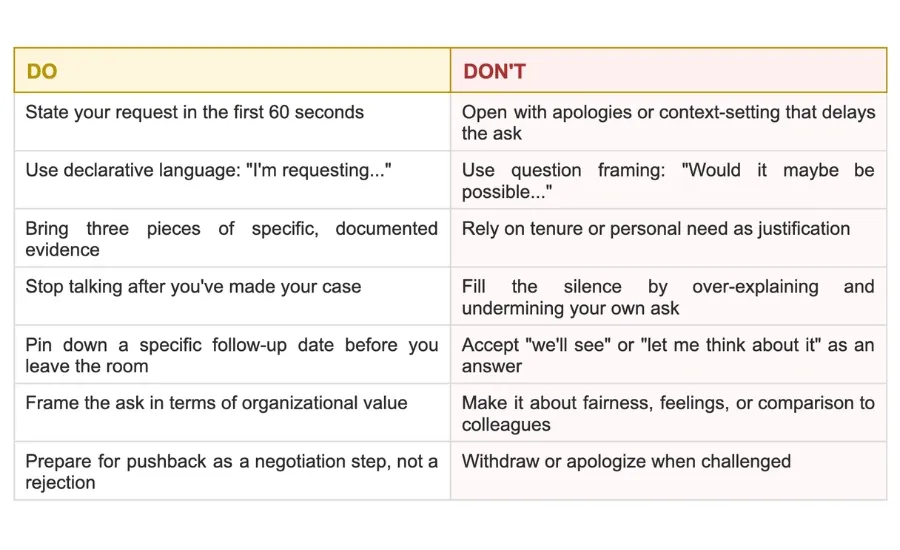
The structure of an effective ask has three components, in this order: state the request, provide the evidence, and stop talking.
Open Without Apology

The opening sets the frame for everything that follows. Compare:
Weak: "Sorry to take up your time, I was hoping we could maybe discuss whether there might be any possibility of looking at my salary at some point..."
Strong: "Thank you for making time for this. I want to discuss adjusting my compensation to reflect the scope of work I am now handling and my contributions to the team."
The second version is not aggressive. It is simply direct. Directness is not the same as aggression, and conflating them is one of the more persistent myths about how professional women should communicate. [INTERNAL LINK: Miranda Priestly and the Leadership Archetype We Are Still Arguing About]
State the Ask in Declarative Language
The phrasing structure matters significantly. Declarative statements open a negotiation. Questions close it before it begins.
"I am requesting a salary increase to $X."
"I would like to propose a move to [title]."
"I am asking for [specific arrangement]."
Notice these are statements, not questions. "Would it be possible..." invites a one-word no. "I am requesting..." invites a discussion.
Present Three Points, Then Stop
State your three strongest evidence points. Then stop. Do not fill the silence. Do not over-explain. Do not soften the ask after you have made it. The person across the table needs space to respond, and nervous elaboration consistently weakens negotiating positions.
Five Strategic Negotiation Scripts You Can Use Immediately
These scripts are templates. Fill in the brackets with your specific data before you use them.
Script 1: Asking for a Salary Increase
RAISE SCRIPT
"I'd like to discuss adjusting my compensation. Over the past [timeframe], I have [specific accomplishment], [specific accomplishment], and [specific accomplishment]. Market data for comparable roles in this geography shows a range of $X to $Y. I am requesting a salary adjustment to $[specific amount]. I am committed to continuing to deliver at this level and want my compensation to reflect that."
Script 2: Asking for a Promotion
PROMOTION SCRIPT
"I want to discuss my path to [specific title]. I have been performing at that level for [timeframe] — specifically, I have [example of higher-level work], [example], and [example]. I believe I am ready for this next step. I would like to understand what the formal process looks like and set a timeline for making it happen."
Script 3: Asking for Flexible Working Arrangements
FLEXIBILITY SCRIPT
"I'd like to propose adjusting my schedule to [specific arrangement]. My track record on [specific projects] demonstrates that I consistently meet deadlines and deliver results regardless of location. I am confident this arrangement maintains or improves my output. I am open to a trial period with defined metrics if that is helpful."
Script 4: Asking for Resources or Headcount
RESOURCES SCRIPT
"I need [specific resource] to deliver on [project or goal]. Without it, the risk to [timeline / outcome / client] is [specific consequence]. With it, I can deliver [specific result]. I am requesting [exact resource]. What do we need to do to make this happen?"
Script 5: Asking for Professional Development Budget
DEVELOPMENT SCRIPT
"I'd like to attend [program/conference]. The skills it develops — specifically [skill] — directly apply to [current project or goal]. The cost is [amount]. I will share learnings with the team afterward. This is an investment that pays back in [concrete outcome]. I am requesting approval."
Strategic Negotiation: The Complete Do's and Don'ts
When the Answer Is No: How to Turn a Rejection Into a Negotiation Timeline
A no in a workplace negotiation is rarely a permanent no. It is usually a no under the current conditions, and understanding what those conditions are is the most useful thing you can do in that moment.
Step 1: Ask for Clarity
"Can you help me understand what is driving that decision?"
This question is not confrontational. It is diagnostic. Budget constraints, timing issues, internal headcount freezes, and concerns about scope expansion are all different problems with different solutions. You cannot address a constraint you do not understand.
Step 2: Ask About Alternatives
If the specific ask is not possible, something adjacent often is. A full raise might not be available, but a performance bonus, additional vacation, a smaller increase with a clear path to more, or an accelerated review timeline might be.
"If [original request] is not possible right now, what alternatives are available?" This keeps the conversation in motion rather than closing it.
Step 3: Get a Specific Timeline
This is the step most people skip, and it is the most important one. "Not right now" without a defined review date is not a deferral. It is a quiet decline.
"What would need to change for this to be possible? Can we set a specific date to revisit this?"
Pin down a date before you leave the room. Write it in an email, follow up the same day. A no with a timeline and defined criteria is a negotiation in progress. A no without either is a closed door.
Step 4: Evaluate What the Pattern Tells You
One no with a clear rationale and a defined path forward is a normal part of workplace negotiation. A consistent pattern of nos, vague deferral with no follow-through, or an absence of any concrete criteria for advancement is information about the environment, not about your worth.
The question to ask yourself after a pattern of rejection is not what you are doing wrong. It is whether this is an organization that has a functional path to what you are asking for.
Frequently Asked Questions: Workplace Negotiation for Women
How do I ask for something at work without sounding demanding?
The framing that reads as demanding is personal entitlement language: "I deserve this" or "I have been here long enough." The framing that reads as professional is evidence-based and value-focused: "Based on my contributions and market data, I am requesting X." Being direct is not the same as being demanding.
What if I do not have hard data to support my request?
Start building it now for the next cycle. In the immediate term, use specific examples, documented feedback, and market research from LinkedIn Salary, Glassdoor, or Levels.fyi. Qualitative evidence is weaker than quantitative evidence, but is significantly better than no evidence at all.
How long should I wait before asking for a raise at a new job?
One year is the general threshold unless your role has materially expanded beyond what you were hired for. Use the first year to document wins, understand organizational budget cycles, and build your evidence file.
Is it appropriate to mention what a colleague earns?
Generally no, and not because it is unfair to ask. It is strategically weak. Comparison to colleagues shifts the frame from your value to organizational equity, which is a different and more complicated argument. Market data for your role is a stronger anchor.
What if my manager has no power to grant my request?
Ask them to advocate on your behalf with whoever does have the authority. "I understand this may need to go up the chain. Would you be willing to support this request with [decision-maker]?" Their backing materially changes the likelihood of a yes.
What should I do if the answer is always 'not right now'?
Pin down the specifics every time: what needs to change, and when. If the pattern continues with no defined criteria and no follow-through on timelines, that is data about the organization's intention, not about the viability of your ask.
Self-Advocacy Is a Professional Skill, Not a Character Trait
One of the more persistent myths in workplace culture is that self-advocacy reflects a certain type of personality. That some people are just "good at asking" and others are not. That confidence is innate.
It is not. Strategic negotiation is a learnable skill with a specific set of mechanics. The preparation framework, the language structure, the evidence approach, the rejection handling protocol. None of this requires a particular personality. It requires practice.
The people who consistently get what they ask for at work are not more deserving than the people who do not. They have, in most cases, simply learned how to ask.
So: prepare the evidence, choose the timing, use the language, and ask.
Related Reading:
• How to Handle Criticism at Work
• How Gender Affects Communication at Work
• Impostor Syndrome and How It Affects Your Performance
• How to Practice Self-Discipline
Sources:
• Harvard Business Review - How to Be Assertive Without Losing Yourself
• FM Magazine - Tips for Asking for What You Want in Today's Workplace