The standard Rosalind Franklin story goes like this: brilliant scientist, stolen work, premature death, belated recognition. It is an accurate summary. It is also not particularly useful, because it frames what happened as an anomaly — as the wrongdoing of a few specific men in a specific decade — rather than as a case study in how institutions actually function when a woman's work produces something valuable.
The second reading is more accurate. And, for anyone working in a professional environment today, considerably more informative.
What Rosalind Franklin Actually Did
This part is worth being precise about, because the popular version tends toward vagueness.
Franklin was a physical chemist who specialised in X-ray crystallography — a technique that uses X-ray beams to determine the structural arrangement of atoms within a molecule. She completed her doctoral dissertation on the microstructure of coal and came to King's College London in 1951 specifically to apply this technique to the structure of DNA, which was then the most pressing open question in molecular biology.
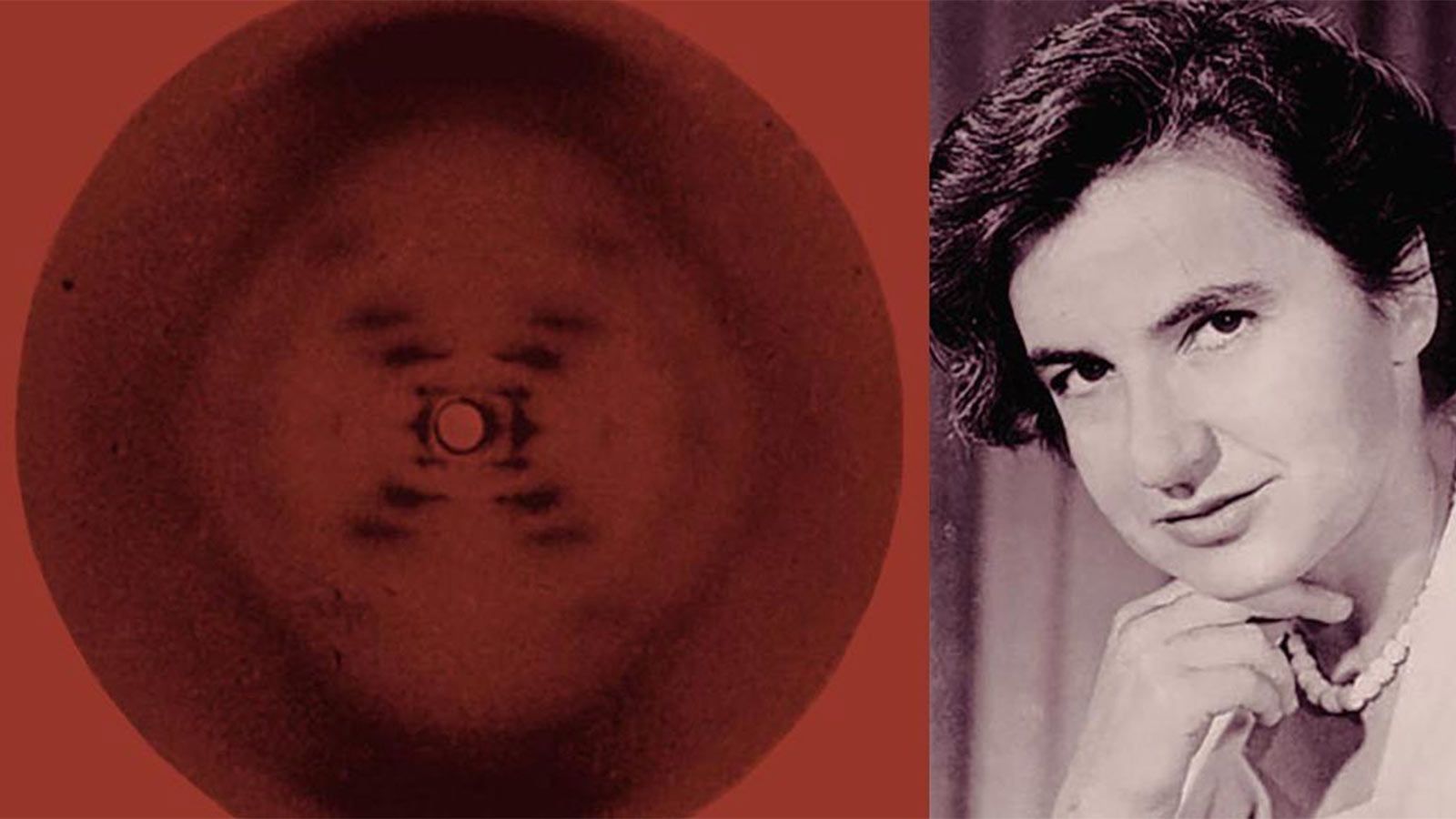
Over the following year, she produced what became known as Photo 51 — an X-ray diffraction image of the B-form of DNA, taken in May 1952. It was the sharpest, most structurally revealing image of DNA ever captured at that point. From it, Franklin derived measurements that confirmed the helical structure of the molecule, calculated its dimensions, and identified the location of the phosphate backbone on the outside of the helix.
These were not supporting observations; they were the central structural data that made the correct DNA model possible.
In January 1953, without Franklin's knowledge or consent, her colleague Maurice Wilkins showed Photo 51 to James Watson. Watson's own account describes the moment: his pulse raced, he immediately understood the significance of what he was seeing, and he left to draw the helix and share it with Crick. Franklin's unpublished research report — also obtained without her knowledge — provided Watson and Crick with the precise measurements they needed to build a working model.
Their paper was published in Nature in April 1953. Franklin's paper appeared in the same issue, placed third, framed as supporting evidence for the model that had been built using her data.
She was 33 years old and she had no idea this sequence of events had occurred.
The Institutional Mechanism — Not the Personal Failing
What made the redistribution of Franklin's work possible was not solely the character of the men involved, though character is relevant. It was a series of institutional structures that operated exactly as designed.
The informal information network.
Watson and Crick were not working in isolation. They were embedded in a scientific community in which findings were discussed informally before publication — at conferences, over lunch, in correspondence. This network was not equally accessible to all researchers, and Franklin, who was already navigating a hostile working environment at King's College and who had a notably formal professional style compared to her peers, was less embedded in this informal exchange than her male counterparts. Her data moved through the network; she did not.
The hierarchy of credit in collaborative environments.
The convention that a paper's first authors receive the credit, regardless of the intellectual foundation underneath the work, was not a new rule invented to disadvantage Franklin. It was standard academic practice. The structural problem is that standard academic practice was developed in environments that were almost exclusively male, where the question of a woman's foundational contribution was rarely relevant because women were rarely present.
The institutional management of inconvenient relationships.
When the working relationship between Franklin and Wilkins deteriorated — which it did rapidly, due in part to a miscommunication at the time of her appointment that left the question of who was leading the DNA research genuinely ambiguous — the institutional response was to reassign Franklin to a different research project. She was moved from DNA to tobacco mosaic virus research, which turned out to be important and productive work. But the reassignment also removed her from the competition at the precise moment when that competition was reaching its conclusion.
None of these three mechanisms required anyone to decide, explicitly, that Franklin's credit would be redistributed. They did not require bad faith. They required only that institutions operated as they normally operated — which is to say, in ways that consistently advantaged people who were already advantaged.
What She Built After
This is the part of the Franklin story that receives the least attention, and it is worth correcting that omission.
From 1953 until her death in 1958, Franklin led a research group at Birkbeck College that produced significant work on the structure of viruses. Her group made critical contributions to the understanding of tobacco mosaic virus, and she was working on the structure of the polio virus when she became ill. The work was foundational enough that her collaborator Aaron Klug received the 1982 Nobel Prize in Chemistry partly for work that built directly on hers. Klug stated explicitly that had Franklin lived, they would have shared the award.
This period of her career matters because it demonstrates something important: Franklin was not defined by what had been done to her at King's College. She built a laboratory, led a team, produced consequential science, and was recognized for it within her field during her lifetime. She died of ovarian cancer at 37, almost certainly caused by her extensive exposure to X-rays, an occupational hazard that was not well understood at the time.
She had, in other words, a full and productive scientific career that the biographical shorthand — "stolen work, no credit" — consistently obscures.
The Nobel Question
The Nobel Prize is not awarded posthumously. This is a rule, not an oversight. When Watson, Crick, and Wilkins received the 1962 Nobel Prize in Physiology or Medicine, Franklin had been dead for four years. The rules of the prize meant she could not have been included regardless of any other consideration.
This is not a justification of the broader sequence of events. It is a structural clarification that matters, because conflating "she didn't receive the Nobel Prize" with "they decided not to give her the Nobel Prize" misrepresents what actually happened. The prize was given four years after her death to the men whose published paper — built substantially on her unpublished data — was the work the committee recognized.
The question the Nobel Prize raises is not whether Franklin should have received it in 1962. The question is what would have happened had she lived — whether the structure of credit that had already been established in 1953 would have been revisited, and whether institutions reliably revisit credit structures once they have been formalised.
The evidence from comparable cases is not encouraging. But that is a different, and harder, question.
What This Means for Working Women Now
The Franklin case is not ancient history that has since been resolved. The specific mechanisms that operated in 1952 and 1953 — the informal information networks that distribute access unevenly, the attribution conventions that formalise first-mover advantage, the institutional management of professional conflict that removes the complicating party — are identifiable in professional environments today. They do not require explicit discrimination to function. They require only that default processes continue to operate as defaults.
The practical read for women working in any institutional setting is this: understand how credit is formalised in your environment before you need to fight for it. The question is not only "who gets recognized for this work" but "at what point, and through what mechanism, does attribution get locked in?" Franklin's data was shared informally before any formal attribution process had occurred. By the time the Nature papers were published, the credit structure was set.
This is not an argument for paranoia or for withholding collaboration. It is an argument for understanding the rules of the environment you're operating in — including the unwritten ones — well enough to navigate them with your eyes open.
Franklin did rigorous science in an environment that was not designed to acknowledge it. The work spoke clearly enough that it eventually could not be ignored. But "eventually" arrived, in her case, too late.
The Inside Scoop: Rosalind Franklin
What did Rosalind Franklin actually discover?
Franklin produced the key X-ray crystallographic evidence that established the helical structure of DNA, including Photo 51 — the most precise DNA image captured at that time. She also derived critical measurements that confirmed the structure of the molecule. This data was central to the model published by Watson and Crick in 1953.
Why didn't Rosalind Franklin win the Nobel Prize?
The Nobel Prize is not awarded posthumously. Franklin died in 1958 of ovarian cancer, four years before Watson, Crick, and Wilkins received the 1962 Nobel Prize. Had she lived, the question of whether she would have shared the recognition is a separate and more contested one.
What is Photo 51?
Photo 51 is an X-ray diffraction image of DNA produced by Rosalind Franklin and her graduate student Raymond Gosling in May 1952. It provided the clearest structural evidence of DNA's helical form and was shown to James Watson without Franklin's knowledge, significantly contributing to the Watson-Crick model.
Was Rosalind Franklin's work stolen?
Her unpublished data and Photo 51 were accessed and used by Watson and Crick without her knowledge or consent. Whether this constitutes theft depends on the standards applied — academic conventions of the time did not clearly prohibit it, which is itself part of the structural problem. What is not in dispute is that her data was used without credit, and that she was unaware of how foundational it had been to the 1953 paper until much later.
Did Rosalind Franklin receive any recognition during her lifetime?
Yes. Franklin's work at Birkbeck College on virus structure was recognised within her field. She presented at conferences, published significant findings, and was respected as a scientist in the viral research community. The narrative that she died unrecognised is incomplete.
The Structural Takeaway
Rosalind Franklin is not primarily useful as a symbol of injustice. She is useful as a precise case study in how institutions process inconvenient people and how the structures that govern credit, access, and attribution can operate to predictable effect without requiring anyone to make an explicit decision.
Understanding the case clearly — not as tragedy, but as mechanism — is more respectful of her intelligence than mourning her fate. She was a scientist. She would, presumably, prefer the analysis.
Bibliography
- Benderly BL (2018). Rosalind Franklin and the damage of gender harassment. Science. https://www.sciencemag.org/careers/2018/08/rosalind-franklin-and-damage-gender-harassment
- Elliot E. (2016). Women is science: Remembering Rosalind Franklin. The Jackson Laboratory. https://www.jax.org/news-and-insights/jax-blog/2016/july/women-in-science-rosalind-franklin#
- Elkin L. (2003). Rosalind Franklin and the double helix. Physics today, 55(3), 42. https://doi.org/10.1063/1.1570771
- Maddox, B. The double helix and the 'injured heroine'. Nature 421, 407–408 (2003). https://doi.org/10.1038/nature01399