
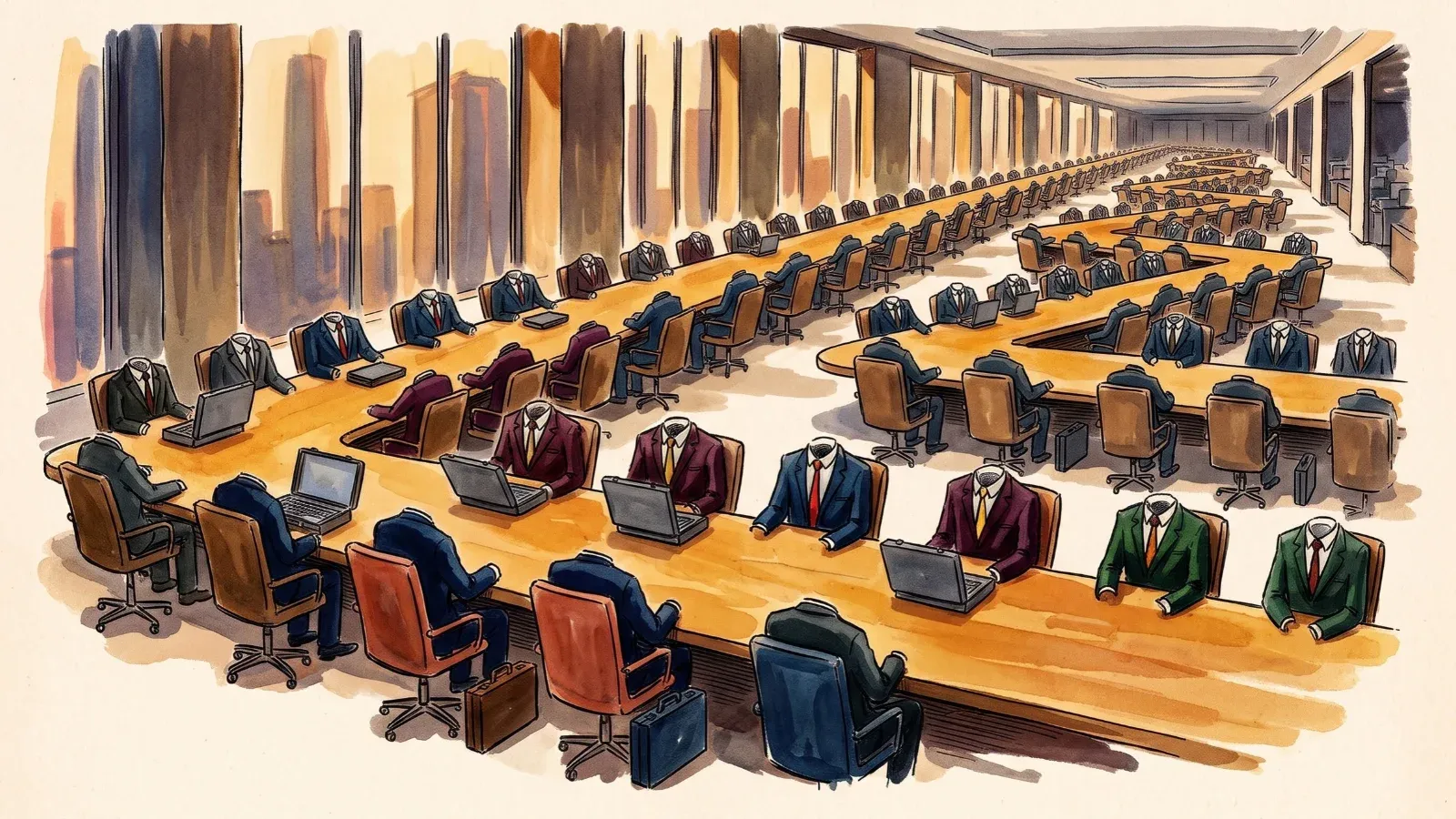
One Zoom call. Three co-founders. Two engineering directors. One middle manager. One Technical Program Manager. Forty-five minutes blocked off to resolve an urgent issue that had blown up the day before.
The call ended. The solution was nowhere to be found.
The Technical Program Manager, new to the company and having spent their career at smaller, sharper outfits where problems got solved, sat staring at their screen in quiet disbelief. After 45 minutes of uninterrupted talking, nothing had progressed. Afterward, they turned to one of the engineering directors, a man who seemed pragmatic enough to get things done (at least until that afternoon), and asked, "Wasn't this meeting supposed to fix the problem?" He answered with a mix of deadpan seriousness and mild exasperation: "Oh, yeah, sure. But we needed to recap."
Seven people, all pulling in six- and seven-figure salaries, had just burned nearly an hour rehashing data they had already held a previous meeting to discuss, walking away with zero decisions.
Welcome to the Western corporate machine, where everyone jokes endlessly about the meetings choking their calendars, yet no one ever stops scheduling them. And across the Atlantic, where the calendar might be slightly lighter, the stall takes another form: forms, approvals, and red tape.
Two Masks of the Same Parody
The United States and Europe love to caricature one another's work habits, yet both have perfected the art of turning motion into a substitute for results.
On the American West Coast, hustle culture treats visible effort like a religion. Walk along the Lake Washington waterfront in Seattle or Kirkland at 10 a.m. on a Tuesday and you will pass trails packed with people in Lululemon leggings, nursing iced matchas while pacing briskly on Bluetooth calls. Two hours later, those same people are on LinkedIn writing earnestly about "grinding" and "executing at scale." East Coast professionals in Boston and New York roll their eyes at the athleisure, then put on tailored wool and stage the same performance indoors with 80-slide decks, late-night email timestamps, and endless board reviews.

Americans wear exhaustion like a badge, and their favorite proof is the clock. According to OECD figures, the average American worker logged 1,796 hours in 2024 against 1,331 in Germany: 465 more hours, or roughly 35% more time on the clock. The U.S. has no federal guarantee of paid vacation, which explains part of that gap. It does not explain a productivity lead, because there is hardly one. In 2023, Germany and the Netherlands each generated $94 of GDP per hour worked, about 3% below the American $97. Organizational researchers Kimberly Elsbach, Daniel Cable, and Jeffrey Sherman showed one reason in a 2010 study on "passive face time": managers routinely read being seen during business hours as dependability and staying late as commitment, whatever the output. Ten hours behind a green status dot is a standoff, not 10-hour work. Nobody wants to be the first to log off.
Europeans like to think they are immune. They take their August holidays, guard their evenings, and roll their eyes at Silicon Valley's obsession with "syncing." But Europe runs the same stall with different props: paper trails, wet stamps, and regulatory checklists instead of calendar invites.
Americans are hardly immune to regulatory bloat, from Sarbanes-Oxley audits to sprawling HR mandates. Europe just operates at a different scale. Mario Draghi's 2024 report on European competitiveness counted roughly 13,000 legislative acts enacted in the EU between 2019 and 2024, against around 3,500 federal laws in the United States (closer to 5,500 if you include congressional resolutions). In tech alone, European firms contend with roughly 100 distinct laws enforced by more than 270 regulators across member states. Draghi found that over 60% of EU companies view regulation as a direct obstacle to investment, while 55% of small and medium-sized enterprises cite administrative burden as their single greatest challenge. An OECD survey spanning 34 member and partner jurisdictions found business organizations in 90% of surveyed countries still consider regulation and bureaucracy excessive. None of it stays in Brussels. It migrates into private firms and swells their compliance and legal departments, until companies spend more money proving they obey the law than building anything worth regulating.
An American hides behind a "recap." A European hides behind a regulation. Same protection, different paperwork.
Dramaturgy in the Digital Age
In 1956, the sociologist Erving Goffman published The Presentation of Self in Everyday Life, arguing that human interaction works like a stage play. We spend our days shifting between a front region, where we perform expected social roles for an audience, and a back region, where we drop the act and get things done. A waiter glides through a dining room with practiced grace, then pushes through the swinging kitchen doors to swear at the line cook. The distinction holds because the kitchen exists.
Modern white-collar work has demolished the kitchen.
When labor meant laying bricks, machining steel axles, or filing typed legal briefs in metal cabinets, output was self-evident. A supervisor could walk past a desk at 4 p.m. and see a stack of finished folders. Today, most office workers spend eight to 10 hours staring at screens, updating spreadsheets, slide decks, and chat threads that leave nothing physical behind. You cannot see a budget coming together inside someone's head, or watch an engineer solve a bug while staring out a window. Because thinking leaves no visible trace, workers invent proxies to prove they are earning their salaries.
Goffman knew that every public role takes some stagecraft. Putting on a suit, holding your temper during a tense negotiation, or staying polite with a difficult client is just normal adult behavior. The trouble starts when the act stops supporting the work and replaces it altogether. A surgeon still has to close the incision; a corporate bureaucrat can spend 10 years looking frantic on Slack without ever finishing anything real, turning the entire workday from 9 a.m. to 6 p.m. into an unbroken performance.
A person sitting quietly with a notebook and a pen, working through a difficult problem without touching a keyboard, looks idle, while someone firing off messages in a chat channel, updating a shared slide deck two minutes before a call, and dropping quick acknowledgments onto every email thread looks indispensable. In a 2025 workplace report combining a survey of 31,000 workers with product telemetry, Microsoft found that the average employee gets interrupted roughly every two minutes during business hours, adding up to 275 pings, alerts, and messages a day once after-hours activity is included, and that PowerPoint edits spike by more than 120% in the final 10 minutes before meetings start. Microsoft sells the very software generating those alerts, so vendor data deserves skepticism. Still, anyone who has worked inside a large company recognizes the scramble: people stay visibly frantic because sitting still looks suspicious.

In Slack’s 2023 State of Work report, employees reported spending an estimated 32% of their week on performative work, roughly 13 hours out of 40 signaling activity rather than producing results. Self-reported surveys inevitably capture frustration alongside actual hours, yet the incentive is clear: Slack itself tied the habit to how leaders measure productivity, which explains why so many people keep a mouse jiggler plugged into their laptops or schedule emails to go out at 9 p.m. Staying online past dinner rarely means a project is getting finished. It means the boss sees a green light before going to bed.
Jargon supplies the camouflage.
Drop into any call in New York, London, or Frankfurt, and you will hear a dialect that barely resembles human speech. Nobody asks a colleague a simple question anymore when they can "reach out," and instead of calling out a bad idea, they "flag a concern" or ask if the team has the "bandwidth" to "unpack" it later. Projects do not finish; they "land." Problems are never solved on the spot, either, because it is always safer to "take them offline" so two people can "circle back" and "align" before the next "touchpoint."
Outsiders love to mock this vocabulary as lazy or pretentious because they miss its real function. Jargon is never meant to clarify anything; plain English handles information far faster. Tell a room full of adults, "This plan will burn half our budget and we should kill it today," and everyone immediately understands you. That is precisely why nobody talks like that. Plain English leaves sharp edges and obvious accountability: say a plan will fail and it succeeds, and you look foolish; back a bad idea and watch it collapse, and the blame lands squarely on you. Saying "let's socialize this deck with stakeholders to build cross-functional alignment" offers nothing concrete, which makes it impossible to disprove or attack; the words just sit there like verbal padding.
Speaking the dialect also proves tribal loyalty. Just as religious communities use shared liturgies to separate believers from strangers, companies use specialized phrasing to test whether you belong. A new hire who walks into a meeting and speaks in blunt, everyday sentences sounds jarring, almost naive, like someone showing up to a black-tie dinner in hiking boots. Fluency in the jargon signals that you have absorbed the unwritten rules: cushion bad news, push conflict down the calendar, and sound busy without ever promising a deliverable by Friday.
Anthropologist David Graeber made the case in Bullshit Jobs (2018): modern economies have produced millions of office roles so pointless that the people holding them cannot privately justify them. When a job produces nothing concrete, the performance becomes the product. You attend the pre-meeting for the alignment call, update the tracker so your manager can summarize it for a vice president, and cycle through the approved phrases until everyone agrees to pretend work happened.
It wears people down. Goffman's actors could step offstage and loosen their collars. In an always-on office, the audience sits in your pocket on a Sunday afternoon. Hard decisions leave a clean, satisfied fatigue. Pretending to be busy all day leaves a hollow drain.
The Architecture of Cowardice
Diffusion of Responsibility
Sensible adults sit through four-hour committee marathons and fill out 40-page compliance forms because large institutions punish visible mistakes far more severely than inaction.
Say a vice president makes a fast, unilateral call to launch a product or change a workflow and loses $2 million. They take the hit alone. Careers stall over single, obvious blunders. Delay that same decision for six months by forming a working group, commissioning three external reviews, and holding nine alignment calls, and nobody gets fired. Even if the market moves on and the company bleeds $5 million through hesitation, the loss gets written off as bad weather. Nobody signed their name to a delay.
In 1968, social psychologists John Darley and Bibb Latané gave this instinct a formal name: diffusion of responsibility. In their famous experiments at New York University, participants heard what sounded like a fellow student having an epileptic seizure over an intercom. Eighty-five percent rushed out to get help when they believed they were listening alone, yet that number dropped to 31% when they thought four other people were on the line. Simply knowing a crowd is present changes how people calculate obligation, because once responsibility is shared across a room, nobody feels personally on the hook.
Corporate structures and state bureaucracies have turned that psychological quirk into standard operating procedure.
On the American side of the Atlantic, the primary insurance policy is the crowded calendar invite. A manager faced with a risky choice immediately invites 11 peers to a meeting, shares a slide deck, and asks for "feedback" and "buy-in." By the time the project finally moves forward, so many people have weighed in, edited the slides, and nodded along on video calls that ownership has been ground into fine dust. When the initiative collapses six months later, the post-mortem turns into an exercise in collective amnesia, because once everyone has been consulted, no one is left to blame.
In Europe, that instinct takes a different form. Instead of spreading blame across a crowded conference room, European institutions bury it under a paper trail. When a regulator in Brussels or a ministry official in Paris demands another impact assessment, another legal opinion, or another round of committee sign-offs, the process is not meant to improve the final result; it exists to build an alibi. If a policy backfires or a project stalls, the official can point to a thick binder of stamps, signatures, and strict adherence to procedure. Since every rule was followed to the letter, the person behind the desk is left untouchable.
This explains why internal attempts to "speed things up" almost always fail. Executives love announcing that they want employees to take risks and move fast, yet their promotion and firing habits reward the exact opposite. People quickly learn that the math never works in their favor: a modest bonus if a unilateral bet pays off, or a quiet exit package if it blows up. Spreading the decision across 10 people or 10 bureaucratic checkpoints flattens that personal risk to zero.
The Self-Preservation of Middle Management
Once an organization builds a culture that avoids individual responsibility, it needs a permanent class of people to manage that avoidance, and middle management stops being a logistical necessity and becomes a self-sustaining industry.
Managers are supposed to clear obstacles so front-line workers can build products or serve clients. Instead, modern corporate hierarchies have swollen with layers of directors, associate directors, program managers, and team leads whose main output is coordination. When you do not write code, close deals, treat patients, or design physical goods, you prove your value through administrative oversight: you schedule the check-in, request the status update, compile the weekly summary, and pass it up the chain to someone whose job is to turn your summary into a monthly deck.
British naval historian C. Northcote Parkinson laid this out in 1955 with Parkinson's Law, his observation that work expands to fill the time available for its completion. Bureaucratic institutions multiply their administrative staff regardless of whether the workload goes up or down. His classic example was the British Admiralty between 1914 and 1928. Over those 14 years, the Royal Navy's fleet of capital ships shrank by roughly two-thirds and its total naval personnel fell by a third, yet the number of shore-based Admiralty officials jumped by nearly 80%. Officials prefer subordinates over rivals, Parkinson noted, and once enough administrators sit in the same building, they generate enough internal paperwork to keep one another endlessly busy.
Sixty years later, the same math governs the modern corporate office. Management theorists Gary Hamel and Michele Zanini analyzed U.S. Bureau of Labor Statistics data and found that between 1983 and 2016, the number of managers and administrators in the American workforce nearly doubled, growing more than twice as fast as all other occupations. They estimated that excess bureaucracy drains trillions of dollars a year from the American economy in lost output and the sheer cost of paying people to supervise one another.

Graeber named the roles that keep this bureaucracy running: taskmasters and box tickers. Taskmasters hand work to people who would do fine unsupervised, or invent busywork to justify their own paychecks. Box tickers let an institution claim on paper that it is tackling a problem while changing nothing. They feed each other: the box ticker drafts a new reporting requirement, and the taskmaster calls three meetings to make sure everyone fills it out properly.
Without the pointless meetings, the status trackers, and the paperwork, a huge share of the middle tier has nothing left to do. People do not volunteer to make their own jobs obsolete, so middle management defends the complexity that justifies its existence. Every new layer of approval is another reason to keep the layer above it. Bureaucracy does not slow the company down by accident; for the people paid to administer it, bureaucracy is the product.
Consensus Theater vs. Decisiveness
Direct orders have gone out of fashion. A plain instruction now feels like an etiquette breach, so managers are trained to solicit input and coax the room toward consensus. It looks egalitarian on paper. In practice it is command evasion dressed up as courtesy.
Real leadership means making a call on incomplete facts when someone in the room will be unhappy about it. That invites open disagreement and leaves no doubt about who decided if things go sideways. Forced consensus removes the discomfort by turning every routine decision into a miniature town hall.
In a 2017 Harvard Business Review study of senior managers, Leslie Perlow, Constance Hadley, and Eunice Eun found that executives spend nearly 23 hours a week in meetings, up from fewer than 10 in the 1960s. Seventy-one percent of those surveyed admitted their meetings were unproductive. The invites keep multiplying anyway, because deciding alone gets you labeled rigid or uncollaborative, while dragging a dozen people into a room to debate every minor detail earns praise for an inclusive style.
European institutions push this habit to absurd extremes. Across Brussels and national ministries, an obsession with "stakeholder consultation" guarantees that before any rule passes or any budget is unlocked, dozens of committees, advisory boards, and working groups have to issue opinions. Officials sell this as democratic legitimacy, yet it breeds institutional exhaustion and bogs down urgent decisions until the final compromise pleases no one.
Consulting smart people before deciding is not the same as stalling until everyone agrees. Competent leaders gather the facts, hear out the people closest to the problem, and stand behind the verdict; weak ones hide behind the room.
The Frankenstein Cycle
During periods of cheap capital and steady expansion, organizations add managers the way people buy furniture for rooms nobody uses. A team of 12 engineers gets a lead, who soon reports to a manager, who answers to a senior manager, a director, a senior director, and a vice president. Each tier needs a reason to exist, so each invents its own weekly reports and quarterly planning. Before long, the company spends most of its energy moving a single decision from the bottom floor to the executive suite.
Then the market tightens, shareholders lose patience, and management panics.
The same executives who approved six layers of oversight announce a crusade against bloat. Between 2023 and 2025 it ran under labels like "the year of efficiency" and "delayering." Layoffs.fyi tracked more than 262,000 tech layoffs in 2023, another 150,000 in 2024, and roughly 123,000 in 2025. At Amazon, Andy Jassy ordered a 15% increase in the ratio of individual contributors to managers, and his memo called out "pre-meetings for the pre-meetings for the decision meetings." Google trimmed more than a third of the managers overseeing small teams. According to Live Data Technologies, middle managers made up nearly a third of corporate layoffs in 2023, up from under a fifth in 2018.
On earnings calls, this is sold as "flattening." Remove the middle layers, the theory goes, and information flows, decisions speed up, and "builders" finally get left alone.

Cutting bodies without changing how decisions get made produces the reverse. Harvard Business School researcher Julie Wulf spent years studying flattened corporations and found that when firms eliminate middle managers, authority rarely flows down to front-line workers. Control centralizes at the top, and senior executives end up with roughly twice as many direct reports and more operational detail than they have time to understand. Gallup's 2025 data put the average manager's team at 12.1 people, up nearly 50% since 2013.
The paperwork does not leave with the people who were fired. The remaining staff inherit it, and the approval chains bottleneck at fewer desks. Management scholar Wayne Cascio's 18-year analysis of S&P 500 companies found that downsized firms were no more profitable than their peers and often suffered sharp drops in performance when cuts hollowed out institutional memory. Wharton's Peter Cappelli noted that sales per employee routinely fall in step with labor costs.
Within 18 months, the second act begins. Directors complain that nothing is shipping, approvals stall, and HR quietly opens requisitions for "program leads" and "operations managers" to restore order. The monster gets stitched back together, layer by layer, until the next downturn calls for the next round of surgery.
The Defense, and Why It Fails
The Scale Argument
Any serious defense of the system begins with a simple point about size: you cannot run a 50,000-person enterprise the way you run a neighborhood bakery. When an organization operates across dozens of countries, manages supply chains, answers to public regulators, and coordinates thousands of interdependent specialists, informal communication breaks down. Structure becomes mandatory.
In 1937, the economist Ronald Coase explained why firms exist in the first place. In his classic essay "The Nature of the Firm," Coase argued that relying entirely on open-market prices entails heavy transaction costs, because finding suppliers, negotiating individual contracts, and monitoring compliance every day would freeze complex production. Hierarchical firms replace those endless market negotiations with internal administrative authority to create what Coase, borrowing a phrase from D.H. Robertson, called "islands of conscious power." Four decades later, the business historian Alfred Chandler reinforced that case in The Visible Hand, showing how 19th-century railroads and telegraph networks required salaried middle managers to coordinate high-volume speed and logistics at a scale the market alone could never achieve.
That argument is sound, as far as it goes. Scale certainly demands clear reporting lines, shared standards, and reliable logistics.
Where the defense collapses is in the confusion of coordination with theater. Coase himself noted that a firm ceases to be efficient the moment the cost of organizing one more transaction internally exceeds the cost of handling it on the open market. Modern institutions crossed that threshold years ago. In a healthy organization, coordination acts like scaffolding around a building: it exists solely to help workers put up the walls, and it comes down once the job is finished. In the contemporary corporate parody, the scaffolding has become the entire structure.
Maintaining clean financial controls so a multinational bank does not violate securities law is a necessary structure. Requiring six levels of managerial sign-off to approve a routine vendor invoice is institutional paralysis. Critical decisions in aviation, medicine, or banking demand redundant checks to prevent catastrophic failure. Run a routine software update or an internal marketing brief through the same paranoid friction and you have managed no risk, just paralyzed the business.
The Protection Argument
The strongest moral defense of European regulation is historical. After a 20th century defined by arbitrary state power, financial crashes, and corporate corner-cutting, Europeans built a dense web of legal rules for a specific reason: to protect ordinary citizens, workers, and consumers from unchecked abuse. Standardizing product safety, guaranteeing labor protections, and forcing banks to hold capital reserves were meant to act as concrete safeguards against disaster.
Sociologist Max Weber recognized the original appeal of that logic more than a century ago. In Economy and Society, Weber described modern bureaucracy as technically superior to earlier, personal forms of rule precisely because it operates according to written files, fixed rules, and formal impersonality. A citizen dealing with a proper bureaucratic office should receive identical treatment regardless of wealth, family name, or political connections. In theory, procedure exists to protect the weak.
Yet Weber also warned that rationalized systems eventually harden into what his translator Talcott Parsons famously rendered as an "iron cage," a rigid apparatus that traps the very people it was built to serve.
Over the past three decades, those protections have turned into self-preservation. The Netherlands and Denmark pair strong labor protections with relatively flat, agile companies, but across the wider European system, overlapping agencies routinely issue contradictory mandates. A BusinessEurope analysis catalogued 68 separate regulatory burdens across EU legislation, and the Commission itself has pledged to cut reporting requirements by at least 25%, or 35% for small and medium-sized firms. None of that stops bad actors from cutting corners. It does keep small, honest firms from entering the market at all.
The alibi logic from earlier applies here too. When a ministry demands three years of impact studies and multi-committee reviews before a bridge gets repaired, the person behind the desk is the one who benefits. If the bridge never happens, nothing went wrong on their watch. If it opens years late and over budget, every signature is in order. A shield is supposed to protect the person carrying it while they move forward. This one got so heavy that nobody can lift their feet.
The Culture and Connection Argument

Ask a manager why a team needs four recurring video calls a week when a single memo would do, and you will almost always get the same word: culture. Without constant check-ins, the argument goes, remote teams drift apart, trust erodes, and colleagues turn into isolated contractors staring at separate screens.
That sounds warm until you look at what happens inside those calls. The same 2017 Harvard Business Review survey found that 62% of senior managers said their meetings routinely failed to bring teams closer together. A 2022 study by Otter.ai and the University of North Carolina at Charlotte found that employees multitask in about 70% of their virtual meetings. Like Microsoft and Slack, Otter.ai sells workplace software, though anyone who has sat through a 40-person status call knows the pattern. People mute their microphones, turn off their cameras when they can get away with it, and answer email in another tab. A grid of tiny faces does not create camaraderie. It creates resentment, because everyone knows their real work is piling up during 20 minutes of small talk about weekend plans.
Real camaraderie comes from shared competence: solving a hard problem, shipping a difficult project on time, then leaving one another alone to enjoy their lives outside the building. An organization that disguises socializing as a "strategic sync" to keep people talking is treating a symptom of overwork with more work.
The Economic Dominance Fallacy
Defenders of the American model always point to the scoreboard: if U.S. companies waste so much time in pointless meetings, why do they still dominate global technology, finance, and innovation?
That objection confuses correlation with causation.
The United States dominates high-growth industries because of deep, risk-tolerant capital markets, a single, unified consumer market of more than 300 million people, world-class research universities, and a legal system that rewards rapid commercial scaling. On top of those structural advantages sits a small group of exceptional engineers, scientists, and entrepreneurs who produce breakthroughs despite the organizational drag around them, not because of it.
A massive, cash-rich enterprise can afford to carry thousands of extra administrators and still look invincible on an earnings call. Giant technology firms print money from monopoly software, cloud infrastructure, and digital advertising built years earlier by small, focused teams. Once the cash machine is running, the corporation can easily absorb the cost of endless alignment meetings, extra product tiers, and internal politics without going bankrupt. The fat itself is a luxury good that only dominant monopolies can afford.
Mistaking corporate bureaucracy for the source of American success is like watching an Olympic sprinter win a race while carrying a heavy backpack and concluding that the backpack makes him fast.
The Employment Cushion Argument
The last refuge of corporate bloat is the fear of mass layoffs: if big firms cut millions of administrative and middle-management jobs, where will all those people go?
That worry treats private companies like welfare agencies and confuses busywork with economic health. Paying thousands of educated adults six-figure salaries to manage internal friction is a hidden tax on the people who actually make things and serve customers. Every dollar spent on layers that serve no purpose is a dollar unavailable for lower prices, higher pay for front-line workers, or new ventures that solve concrete problems. It also keeps smart people from building skills that travel, so they are stranded the day the layer gets cut anyway.
Protecting jobs that produce nothing postpones the reckoning.
None of this is an argument for mass layoffs. The Frankenstein cycle shows what happens when a company fires people and keeps the process: the paperwork stays, the bottlenecks tighten, and the layers grow back. The answer is to stop building layers nobody needs, so there is nothing to purge later. Talent and capital freed from phantom jobs go into leaner, faster companies. And if a society wants a safety net, it can fund one directly, which is cheaper and more honest than paying people to slow productive organizations down from the inside.
Reclaiming Real Work
Motion vs. Output
Escaping this parody starts with separating motion from output.
Most modern offices measure labor by endurance because endurance is easy to watch. Sitting in front of a laptop from eight in the morning until six at night, answering messages within 40 seconds, and keeping a calendar packed with half-hour blocks looks industrious from across a glass partition or through a green status indicator. Yet human cognition does not operate like an assembly line. Few people can write a sharp legal argument, solve a stubborn engineering problem, or build a coherent financial model across a ten-hour day. After three or four hours of concentration, the brain degrades into low-grade maintenance, shuffling pixels and replying to emails simply to stay awake.
In Slack's 2023 Workforce Index survey of more than 10,000 workers across six countries, respondents reported that their ideal workday includes roughly four hours of uninterrupted focus time. Everything beyond that window tends to dissolve into busywork. Still, corporate etiquette punishes anyone who finishes their real cognitive work by one in the afternoon and closes their laptop. So people stretch three hours of intense execution across 10 hours of availability.
Consider two ways of spending a Tuesday. In the first, an analyst spends the morning jumping between four status calls, tweaking formatting on a shared deck, and monitoring three chat channels while trying to draft a quarterly forecast in seven-minute fragments. By seven at night, the forecast is half-finished, full of small errors, and the analyst feels completely drained. In the second, that same analyst silences every notification at nine, spends three unbroken hours examining the raw numbers, writes a clear two-page memo with an explicit recommendation, and sends it out before lunch.

One looks exhausted; the other finished the job.
Until organizations judge people strictly by finished artifacts rather than visible availability, rational employees will keep choosing theater over speed. Why finish a complex task in three focused hours if your reward is three more pointless meetings to fill the afternoon? Productivity requires protecting uninterrupted blocks of silence, accepting that deep thinking looks like doing nothing from the outside, and judging the day by what exists at five o'clock that did not exist at nine.
Someone will inevitably ask: if the system pays well for pretending, why not simply collect the paycheck and play along? Because the bargain is a trap. Trade 40 or 50 hours a week of your finite adult life for fake urgency and you slowly hollow out your own competence, until you can't survive outside the theater.
The Guilt of the Autonomous Worker
Anyone who steps outside traditional corporate theater (whether as an independent operator, a business owner, or a disciplined professional working autonomously) eventually runs into a strange psychological hangover: guilt.
When you spend years inside institutions that equate suffering with virtue, working on your own terms feels mildly illegal. For a salaried employee trapped inside a traditional hierarchy, staying visible is simply a survival tax; for anyone who finally owns their own schedule and output, carrying that reflex forward is self-sabotage. Yet if you sit down at seven in the morning, finish three hours of intense, unbroken execution, close your laptop at noon to walk outside or eat a proper lunch, and return later to handle two more hours of decision-making, a quiet voice in the back of your head still insists you are slacking off. You look at friends chained to their monitors late in the evening, complaining about back-to-back calls, and you catch yourself apologizing for having control over your own afternoon.
That guilt is completely backward.
True autonomy has nothing to do with working less. It means refusing to confuse performative exhaustion with real production.
A surgeon who completes a difficult operation in 90 minutes does not owe the hospital six extra hours spent pacing the hallway just to look tired. A writer who drafts 2,000 clean words before lunch has already done more real labor than an entire committee spending all day editing a 15-slide presentation. When your livelihood depends directly on what you ship rather than how long you sit at a desk, pacing yourself around human energy rather than arbitrary clock hours is basic competence.
Corporate culture breeds guilt in autonomous workers because institutional survival depends on everyone staying inside the same cage. Watching someone produce serious work without the misery, the frantic calendar, or the late-night emails exposes how unnecessary the surrounding machinery is. Letting go of that guilt means accepting a simple reality: nobody hands out trophies for how miserable you looked while getting the job done.
Building Without the Parody
Drop both the American calendar circus and the European paper fortress, and what remains is not chaos. It is simply adult competence.
Organizations and individuals that refuse both models operate on a few boring rules. First, every problem belongs to a single human being with a name, a deadline, and the authority to act without forming a committee. Consultation happens quickly and privately before a choice is made, never as a public ritual to dilute blame afterward. If a decision goes wrong, one person owns the mess, fixes it, and moves on.
Second, writing replaces talking whenever information needs to move. Instead of dragging 12 people onto a 45-minute call to read aloud from slides, someone writes two straightforward pages explaining the problem, the numbers, and the proposed action. Everyone reads it in silence, leaves direct notes if something is missing, and the work proceeds. And to keep writing from turning into its own rigmarole, those memos stay brief, unpolished, and authored by one person, never vetted by three layers of editors before anyone is allowed to read them. Status updates live inside the project itself, not in weekly recaps designed to reassure nervous supervisors.
Third, rules exist solely to prevent disaster, never to punish speed. A lean team trusts smart adults to exercise judgment rather than wrapping every minor purchase, hire, or product change in 40 pages of paperwork.
When you drop the performance, days stop feeling like an obstacle course of notifications, approvals, and polite evasions. People think hard, build tangible things, make fast calls, and go home with their energy intact, because none of it was wasted pretending to work.
Somewhere right now, a calendar invite is popping up on a screen for a "pre-alignment" sync, while across the Atlantic, a civil servant is opening a fresh compliance binder to stamp page one. Both institutions will spend the afternoon congratulating themselves on their diligence, and neither will notice how little moved by five o'clock.
The Technical Program Manager from the beginning, by the way, didn't last long. They left for a smaller company, taking lower pay in exchange for faster decisions. At least the meetings were cut in half.