

Psychologists call habitual excuse-making self-handicapping. It is not laziness; it is a subconscious defense mechanism designed to protect your self-esteem from the anxiety and shame of potential failure. By blaming external factors (time, energy, bad timing), your brain preserves your self-image at the cost of long-term growth.
Every one of us has, at some point, made excuses for not doing something or not changing something. We've all found ourselves in a phase where something was holding us back from taking action. As someone who doesn't particularly love change, I used to say that classic "I cannot" until I discovered that I actually could—and all my previous thoughts were just excuses dressed up as facts.
Excuses always find room to fit into our lives. They especially love our negative self-talk. They survive on our procrastination and denial. "Okay, it doesn't matter, I still have time" and countless variations keep excuses in the leading role of our lives.
But what is our position in all this? And why do our brains keep generating these excuses even when we know they're holding us back?
Why Do We Make Excuses? The Psychology Behind It
Psychologists have a term for this pattern: self-handicapping. It's a behavior we engage in that actually hurts our own performance and motivation—but it serves a deeper, often unconscious purpose: protecting ourselves from anxiety and shame.
According to research from Headspace and the University of Florida, excuses aim to shift focus from issues that threaten our sense of self to issues that feel less personal. When someone asks why you failed at something, anxiety kicks in. Your subconscious quickly tries to protect your self-image, and before you know it, you've blurted out an excuse that places blame on something external—something that wasn't your fault.
The more anxious or ashamed we're likely to feel about potential failure, the more likely we are to build barriers that actually prevent us from succeeding. It's a protective mechanism that, ironically, creates the very outcome we're trying to avoid.
Research shows that self-handicapping is correlated with low self-esteem, perfectionism, and elevated concerns about how others evaluate us. People who are afraid of being seen as "impostors" tend to make more excuses. It's not about laziness or lack of character—it's about fear.
The 5 Most Common Excuses We Make (And What They Really Mean)
Let's look at the most common excuses—ones you've probably used yourself—and examine what's actually happening beneath the surface.
"I don't have the time."
I'm quite sure there's always time. Whatever your schedule looks like, you have time to change something you don't like or do something for yourself. I don't believe that you can't find time for a walk in the park or coffee with friends during your week. Time management is ultimately a matter of priorities. If you say you don't have time, what you're really saying is that it's not a priority—and that's worth examining honestly.
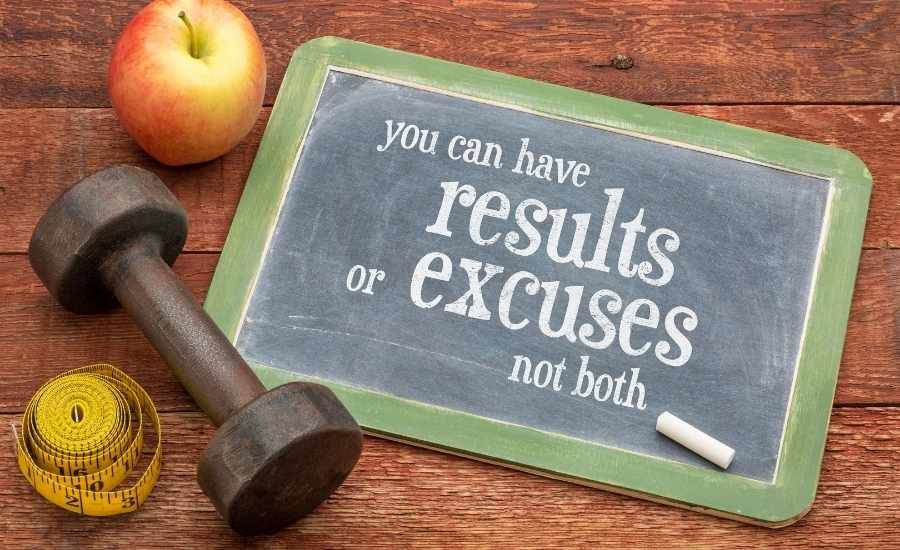
The real issue often isn't time—it's energy, motivation, or fear of what starting might reveal about us. It's easier to say "I'm too busy" than "I'm scared this won't work out."
"I don't have the money."
I could accept this excuse partially, but not completely. What gives us satisfaction isn't always expensive. Sometimes the simple, free things provide the most joy. A walk, an old book from your shelf, time with someone you love—these don't cost anything, but they can change your perspective entirely.
When money becomes the excuse for everything, ask yourself: Is this actually about money, or is money a convenient reason to avoid taking action? Many meaningful changes—learning something new, improving a relationship, taking better care of your health—require little to no financial investment.
"I'm too tired."
You are tired—I have no doubt about that. Who isn't? Everyday life is demanding for everyone. We take on many roles and responsibilities. But from my personal experience, I'll say that some of the times I was most exhausted were also when I felt most satisfied with myself. Sometimes pushing yourself a little to do something different actually generates energy rather than depleting it.
The distinction matters: Are you genuinely depleted and need rest (which is valid and important), or are you using tiredness as a reason to avoid discomfort? Only you can answer that honestly.
"I'm afraid I'm going to fail."
This is perhaps the most honest excuse—and the one underlying many of the others. Fear of failure immobilizes us and makes us victims of circumstance rather than agents of our own lives.
But here's the thing about failure: it's the only way to see your mistakes and correct them. The biggest disappointment in life isn't failing—it's never taking the risk. What kind of life would it be without any risk? A little boring, honestly. When you're scared, it often means you're on the right path—the path that leads to growth.
"The right time hasn't come yet."
Good planning helps us organize our goals. But what about the situations you're already in that don't satisfy you? Why stay somewhere—personally or professionally—that makes you unhappy while waiting for the "perfect" moment?
The right time will never be found. Something will always be happening. Life doesn't pause to let you make changes in ideal conditions. You don't have to wait for external circumstances to align perfectly. You're in charge of your life, not your circumstances.
What's Really Driving Your Excuses
Understanding why we make excuses helps us address the root cause rather than just fighting the symptoms. Here are the psychological drivers researchers have identified:
Protecting self-esteem:
Excuses serve as a defense mechanism. When faced with criticism or potential failure, we use excuses to justify our behavior or performance, preserving our sense of self-worth. Research shows that excuses shift causality from sources that threaten our self-image to sources that feel less personal.
Avoiding responsibility:
By blaming someone or something else, we can avoid facing the consequences of our choices. This feels protective in the moment, but prevents us from learning and growing from our experiences.
Lack of confidence:
Sometimes we make excuses because we genuinely don't believe we're capable of achieving something. The excuse becomes a way to avoid putting ourselves in a position where we might fail—and confirm our deepest fears about ourselves.
Staying in the comfort zone:
Stepping outside what's familiar is scary. Excuses provide convenient reasons to avoid taking risks or facing challenges that would require us to grow.
Habit:
For many people, excuse-making becomes automatic. Neuroscience research shows that habits are neural pathways carved deep in the brain's basal ganglia, reinforced by dopamine. The good news? The prefrontal cortex can help us form new habits that override the old ones—though the old patterns don't disappear entirely; they're just tucked away.
The Hidden Cost of Excuses
Here's something important: while excuses might provide temporary relief or protection, they can ultimately become obstacles to your personal growth and prevent you from achieving your full potential—at work and in life.
Research from the University of Florida found that excuses that are perceived as deceptive, ineffectual, or self-absorbed damage relationships and credibility. People who constantly make excuses are seen as less trustworthy and less competent—even when their excuses are technically true.
The internal cost may be even higher. When we use excuses to avoid discomfort, we reinforce the belief that we can't handle challenges. Each excuse becomes evidence that we need protection from difficulty. Over time, this erodes confidence and creates a self-fulfilling prophecy where we become less capable precisely because we've been avoiding the experiences that build capability.
Excuses are essentially false narratives we use to persuade ourselves not to do things. When we recognize that, we can stop defining our lives based on stories that aren't true.
How to Stop Making Excuses: 5 Practical Steps That Work
Breaking the excuse habit requires conscious effort, but it's absolutely possible. Here's how to start:
How to Stop Making Excuses: 5 Practical Steps That Work
1. Develop Granular Self-Awareness
Pay close attention to when and why you make excuses. Is it driven by perfectionism, fear of judgment, or emotional exhaustion? Notice the recurring scripts you rely on. When you catch yourself offering a justification, pause and ask: What specific consequence am I trying to avoid facing right now?
2. Reframe Internal Language and Own Your Agency
Replace disempowering defaults like "I can't" or "I don't have time" with radically honest statements like "I am choosing not to prioritize this today." Acknowledging that your schedule and decisions are active choices shifts you from feeling like a passive victim of circumstance to being in control of your trajectory.
3. Create External Accountability Systems
Accountability reduces the cognitive room for self-deception. Partner with a colleague or mentor who will directly challenge rationalizations, or use a daily written habit log. Externalizing your commitments makes habitual excuses obvious before they become behavioral patterns.
4. Face Discomfort Through Micro-Actions
Excuse-making thrives when a task feels overwhelmingly high-stakes. Break the threatening objective into micro-steps that trigger zero emotional resistance. Completing a 5-minute action disarms the brain's threat-detection response and builds tangible evidence that you can handle discomfort.
5. Focus Exclusively on Controllable Variables
Many chronic excuses center on unpredictable external factors: economic climate, bad timing, or other people's moods. Anchor your daily focus strictly to what is within your immediate operational control: your effort, your focus, and your willingness to adapt under imperfect conditions.
A Note on Self-Compassion
Addressing excuse-making isn't about beating yourself up or striving for impossible perfection. Sometimes what looks like an excuse is actually a legitimate limitation—and that's okay. The goal isn't to eliminate all boundaries or push through every obstacle regardless of cost.
The goal is honesty. It's knowing the difference between "I genuinely need rest" and "I'm using tiredness to avoid something uncomfortable." It's recognizing when you're protecting yourself from growth versus protecting yourself from genuine harm.
Research actually shows that people who make successful excuses for poor performances often do better the next time they try—because they've preserved their belief in themselves as capable people. Self-compassion and accountability aren't opposites; they work together.
Taking Back Control
We all need to think seriously about what's holding us back. Once we recognize that excuses are stories we tell ourselves—not facts about reality—we gain the power to write different stories.
Taking responsibility for your actions and facing challenges directly will be the first great step toward an excuse-free life. Not a perfect life—just an honest one, where you're in the driver's seat instead of letting fear and avoidance steer.
And once we realize what we actually want—and stop letting excuses convince us we can't have it—we'll feel freer than we ever imagined.
Frequently Asked Questions: The Psychology of Making Excuses
What is the psychology behind making excuses?
In psychological terms, habitual excuse-making is categorized as self-handicapping. It functions as an unconscious defensive maneuver to safeguard self-esteem from the vulnerability of failure. By attributing shortcomings to external variables like time constraints, fatigue, or bad timing, the subconscious shields self-worth and deflects perceived threats to personal competence.
Why do some people always make excuses for bad behavior or missed goals?
People who chronically make excuses often struggle with elevated fear of negative evaluation, deep-seated perfectionism, or impostor phenomenon. When self-worth is fragile, admitting error or lack of follow-through feels emotionally catastrophic. Constructing an elaborate excuse provides an immediate emotional shield, even though it gradually compromises trust and interpersonal credibility over time.
How do you stop someone else from always making excuses?
When dealing with a colleague or partner who habitually makes excuses, avoid debating the validity of their reasoning. Instead, redirect the conversation toward future ownership and solutions: "Regardless of the unexpected obstacles, what concrete adjustments will you make to ensure this milestone is met on the next iteration?" This bypasses defensive narratives and refocuses energy on tangible accountability.