

As a psychologist, I have a specific reaction when clients tell me they have started a gratitude journal to manage burnout. This is not skepticism about gratitude. It is a concern about the framing. Because what I often see is someone who is actively overwhelmed, working unsustainable hours, carrying a cognitive load that has long exceeded their capacity, sitting down at the end of the day to write three things they are grateful for, and using that ritual to convince themselves they can keep going.
However, that is not gratitude practice, it’s rather a coping mechanism deployed in the service of a situation that should be changed. And the distinction matters enormously, both for your mental health and for how effective gratitude actually is as a tool.
Used correctly, meaning with clinical precision, not aesthetic intention, gratitude is one of the most well-supported psychological interventions in the research literature. It produces measurable changes in cortisol regulation, prefrontal cortex activation, and the brain's threat-processing system. It is documented in over 40 peer-reviewed studies as an effective component of burnout prevention for high-stress professionals. It is not a trend. It is a mechanism. And mechanisms need to be understood before they can be used correctly.
The Cortisol vs. Dopamine Battle: What Happens in Your Brain During Gratitude Practice
The neurological case for gratitude is built on a well-understood conflict between two competing brain systems: the amygdala, which processes threat and activates the cortisol stress response, and the prefrontal cortex, which manages executive function, decision-making, and goal-directed behavior.
For most high-achieving professional women, the amygdala is chronically overactive. Sustained high-demand environments — tight deadlines, high stakes, constant evaluation, the specific cognitive load of managing professional ambition alongside everything else — keep the threat-detection system in a state of low-grade but persistent activation. This produces the chronic cortisol elevation that is the physiological signature of burnout.
How Gratitude Activates the Prefrontal Cortex
Research using fMRI imaging has demonstrated that gratitude practice activates the medial prefrontal cortex, the region associated with moral cognition, social bonding, and reward processing. This activation is not passive, it actively competes with amygdala dominance.
The mechanism is direct: the prefrontal cortex and amygdala are in an inhibitory relationship. When prefrontal cortex activation increases, amygdala activation decreases. This is the neurological basis for the observation that gratitude practice reduces anxiety, not because it makes problems disappear, but because it shifts the brain's processing center from threat-detection to evaluation and judgment.
For a working woman making high-stakes decisions under sustained pressure, the practical implication is significant. A brain running primarily on amygdala activation is in threat mode: narrowed attention, risk aversion, catastrophizing, cognitive tunnel vision. A brain with elevated prefrontal cortex activity has a broader attentional scope, better access to creative problem-solving, and improved capacity to tolerate uncertainty without escalating to panic.
These Are The Most Effective Leadership Books You Will Ever Read
Gratitude practice is, in this context, a prefrontal cortex activation exercise. Three to five minutes of deliberate, specific gratitude notation produces a measurable shift in which brain system is dominant. That shift has downstream effects on every decision, interaction, and cognitive task that follows.
The Dopamine and Serotonin Component
Beyond the cortisol-reduction effect, gratitude practice is associated with increased dopamine and serotonin activity. Both neurotransmitters play roles in motivation, mood regulation, and the brain's reward system.
The relevant mechanism here is specificity. Generic positive thinking produces minimal neurochemical response. Specific, detailed gratitude, the kind that requires you to identify exactly what happened, why it mattered, and how it connects to your own agency or others' contribution, activates the reward processing pathways more robustly. This is why "I am grateful for my health" produces less measurable effect than "I am grateful that I managed to run three times this week despite the workload, which tells me my capacity for follow-through is intact even under pressure."
When Gratitude Becomes Dangerous: Signs You Are Using It to Mask Burnout
This is the section most gratitude articles do not include, and its absence is part of why gratitude has developed a toxic positivity association in professional circles. The association is not unfair. Gratitude is routinely misapplied as a tool for endurance when it should function as a tool for clarity.
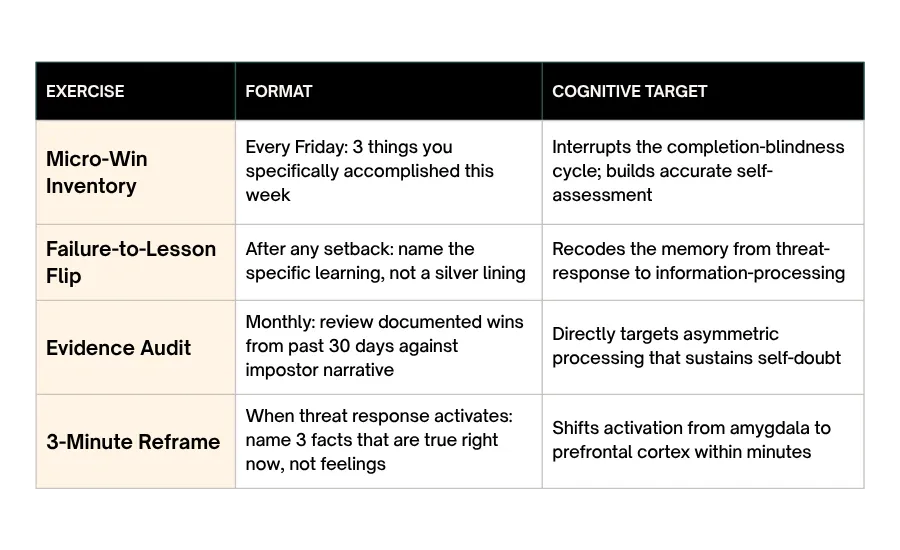
The diagnostic question is: what is gratitude practice producing in your behavior? If regular gratitude practice is helping you see options more clearly, make decisions with less anxiety, and maintain the energy to take action, it is functioning as a shield. If it is helping you stay functional in a role, relationship, or environment that is actively damaging your health, it is functioning as a mask.
The Four Warning Signs
You practice gratitude to justify staying. If your internal monologue is "I should be grateful for this job" as a reason not to have a difficult conversation with your manager or not to look for alternatives, the practice has inverted. Gratitude should expand your sense of agency, not suppress it.
Your gratitude practice follows anxiety rather than preceding it. If you only reach for gratitude when you are already in a state of overwhelm — as a method of talking yourself down — it is functioning as damage control rather than as a preventive practice. Its neurological effect is strongest when used proactively.
You feel guilty for not feeling grateful. This is the clearest indicator of toxic positivity in the practice. Gratitude is not an obligation. Forcing it when the actual emotional content is exhaustion, anger, or grief produces cognitive dissonance rather than regulation.
Nothing is changing despite sustained practice. Gratitude practice that produces regular positive shifts in your nervous system and cognitive state, but is not translating into any behavioral change or improved circumstances, needs a structural reassessment. The tool is working. The environment requires a different intervention.
Learn how High Achievers Use Impostor Syndrome as a Performance Signal
What the Research Actually Supports: Evidence-Based Gratitude Practice
The original research that established gratitude's psychological effects, including Emmons and McCullough's landmark 2003 study, used a specific methodology that has frequently been stripped out of the wellness industry adaptations. Understanding what the research actually tested produces a different and more effective practice than the "write three things" version most people encounter.
What the Research Used
Weekly (not daily) gratitude notation, in detail, with specific attribution of cause
Comparison of outcomes, not merely listing of positive experiences
Connection between gratitude items and personal agency or others' deliberate contribution
Duration of five to ten minutes per session, not rapid bullet-point logging
The studies that found the strongest effects used weekly practice rather than daily practice, primarily because daily gratitude notation tends toward repetition and loses specificity over time. Specificity is the active ingredient. Without it, the neurological activation described above diminishes significantly.
What Reduces Effectiveness
Generic items with no specific attribution ("grateful for my family" repeated weekly)
Forced positive framing of genuinely negative experiences without processing the negative component first
Using gratitude as a replacement for problem-solving rather than alongside it
Practicing exclusively during periods of acute stress, without baseline regular practice
The Working Gal Implementation: Four Executive-Level Exercises
These exercises are derived from cognitive-behavioral and positive psychology protocols adapted for professional contexts. They are structured cognitive interventions with specific mechanisms.
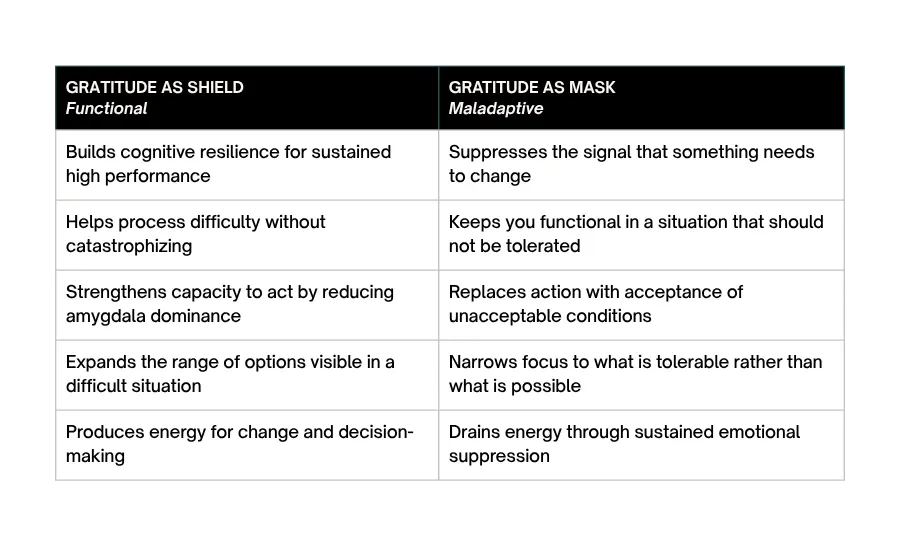
Exercise 1: The Micro-Win Inventory (Weekly, Friday)
Every Friday, before you close your laptop, write three things you specifically accomplished this week. Not things that went well. Not things you are grateful for in a general sense. Things you did.
The specificity requirement is critical. "Had a productive week" is not an entry. "Completed the Q2 analysis two days early despite the client change request" is an entry. "Managed the difficult conversation with the contractor without it escalating" is an entry.
The psychological mechanism targeted here is completion blindness, meaning the tendency to process completed tasks as simply removed from the to-do list rather than as evidence of capability. Completion blindness is a significant contributor to the impostor syndrome cycle described in the research: achievements are processed as obligations fulfilled rather than as demonstrations of competence. The Micro-Win Inventory interrupts this by requiring deliberate attention to what was accomplished and by whom.
Exercise 2: The Failure-to-Lesson Flip
After any professional setback — a missed target, a presentation that did not land, a project that ran over scope — apply this specific two-step protocol within 48 hours:
Name the specific failure clearly. Not a softened version. The actual thing that went wrong, as precisely as you can state it.
Name the single most specific thing you now know that you did not know before. Not a silver lining. Not "at least." A specific piece of information that has value for the next attempt.
The distinction between this exercise and toxic-positive reframing is the first step. You are not being asked to find the good in a bad outcome. You are being asked to extract information from it. The gratitude element is not for the failure itself but for the learning, and only after the failure has been clearly named, not instead of naming it.
This exercise targets memory reconsolidation. The way a memory is processed at the time of formation affects how it is stored and retrieved. A setback processed as a threat activates the amygdala-dominant stress pathway and is stored as a negative emotional memory. A setback processed as information activates the prefrontal cortex evaluation pathway and is stored with less emotional charge. The same event, processed differently, produces a different neurological record.
Exercise 3: The Evidence Audit (Monthly)
Once per month, review your documented wins from the past 30 days. If you are running the Micro-Win Inventory weekly, you have four entries to work from. If you are not yet using that system, your performance review notes, positive feedback emails, and project completion records are the source material.
The purpose of the Evidence Audit is not motivational. It is corrective. Its function is to directly confront the asymmetric processing described in the impostor syndrome literature: the cognitive tendency to accept failure as definitive evidence of incompetence while discounting success as luck, circumstance, or help from others. A monthly audit that requires you to look at four weeks of documented, specific accomplishments makes that asymmetry harder to maintain.
Exercise 4: The 3-Minute Reframe
This is the acute intervention for use when the threat response has already activated, before a high-stakes meeting, during a period of acute professional stress, after receiving difficult feedback.
The protocol: stop. Name three things that are factually true right now. However, not positive things, nor things you are grateful for in the conventional sense. Things that are accurate. "The presentation is prepared." "I have delivered similar work successfully before." "The feedback was about this specific deliverable, not about my overall capability."
The mechanism is the same prefrontal cortex activation described above. The amygdala operates on pattern-matching and threat generalization. Factual specificity interrupts the generalization process. Three specific true statements are usually sufficient to shift the brain's dominant processing mode enough to allow executive function to operate.
Learn How To Do Brain Dump Before Sleep
Frequently Asked Questions: Gratitude Practice for Professional Women
Is there a best time of day to practice?

The research does not strongly support a universal optimal time. Morning practice tends to influence attentional orientation throughout the day — what you prime your brain to notice. Evening practice tends to support sleep quality by reducing the amygdala activation associated with unresolved cognitive load. The most important variable is consistency, not timing. A consistent five-minute practice three to four times per week produces better outcomes than a daily practice that is frequently skipped.
Does gratitude practice work during active burnout?
It has limited effectiveness as the sole intervention during active burnout. Burnout involves physiological depletion that requires structural changes — workload reduction, recovery time, often professional support — that gratitude practice cannot substitute for. What it can do during burnout is support the prefrontal cortex activation needed to make clear decisions about what needs to change. Used in that context — as a tool for decision-making clarity rather than endurance — it remains valuable.
How is this different from toxic positivity?
The difference is in what the practice requires of you before the gratitude is named. Toxic positivity asks you to reframe negative experiences as positive without processing their actual content. Evidence-based gratitude practice, as described here, requires you to name what is accurate, including difficult realities, before identifying what is worth noting as positive. The Failure-to-Lesson Flip is the clearest example: the failure is named first, specifically, without softening. The learning is named second.
Can gratitude practice replace therapy?
No. It is a self-directed cognitive tool, not a clinical intervention. For professionals managing active anxiety disorders, clinical burnout, or trauma responses, gratitude practice may be a useful component of a broader treatment plan but is not a replacement for professional support. If the practice is producing guilt, forced positivity, or is being used to tolerate situations that require structural change, that is worth discussing with a professional.
The ROI of Perspective
The case for gratitude as a professional tool is not motivational. It is neurological and behavioral, and it is documented in the research literature at a level that most corporate wellness initiatives do not approach.
The brain under chronic cortisol load makes worse decisions. It catastrophizes more, sees fewer options, takes longer to recover from setbacks, and degrades the quality of the relationships it depends on. The brain, with regular prefrontal cortex activation through structured gratitude practice, does the opposite. That is not a wellness benefit. That is a performance variable.
The exercises in this article are not difficult. They require five to ten minutes per week in total and produce measurable cognitive effects within 30 days of consistent practice. The condition is that they be done with specificity, not with aesthetic intention.
Candles and a beautiful journal are optional (and always welcome). The specificity is not.
Disclaimer: This article provides general psychological information for educational purposes. It does not constitute clinical advice or a substitute for professional psychological support.