

I have been to hundreds of networking events across Seattle, New York, Athens, Paris, and every mid-size conference hotel in between. I have held a lukewarm glass of wine, exchanged pleasantries about commute times, and collected business cards that went straight into the recycling the next morning. For years, I convinced myself that more conversations equaled better networking. I was wrong, and the proof was in the results: connections that led nowhere, follow-up emails that disappeared into inboxes, and the persistent feeling that I was performing networking rather than actually doing it.
So, when I stopped measuring events by the number of people I met and started measuring them by the number of conversations I remembered the next week, there was a huge shift. Almost always, those were the ones that had lasted long enough to become real. Seven minutes, roughly. Ok, I wasn’t timing myself, but I realized that seven minutes is the threshold at which a professional conversation crosses from introduction to interaction, aka the point where both people have said something that actually matters.
We run a media brand. Our time is the constraint. And once I applied that lens to networking, that is treating every conversation as a professional investment that either earns a return or does not, the entire practice changed.
The Working Gal Salary & Sanity Survey 2026
Anonymous, 3 minutes, for an upcoming Working Gal report on women's work and money.
Take Survey (opens in a new tab)Why 'Working the Room' Is an Amateur Strategy

The conventional networking playbook says: move fast, collect contacts, follow up later. It is the professional equivalent of spray-and-pray marketing. It produces a large list of people who do not remember you and a follow-up inbox full of messages that start with "Great to meet you at [specific event]!" and have nothing substantive to say after that.
The data does not support the volume approach. Research tracking 65,000 business professionals found that after 7 to 7.5 minutes of one-directional conversation, attention drops sharply. The same research found that two-way interaction resets the attention window. This means every superficial two-minute conversation you have at a networking event is leaving before the attention threshold that makes you memorable.
The professionals who build genuine networks do not work rooms. They occupy them strategically. They identify the three to five people worth a real conversation, invest in those, and leave early if that is what it takes to protect the quality of the interactions they have had.
Quality compounds. A contact who actually knows what you do, what problem you solve, and how you think is worth twenty people who vaguely remember your name.
The Psychology of the 7-Minute Reset: Why the Clock Matters
The 7-minute threshold is not arbitrary. It maps onto two well-documented cognitive phenomena that determine whether someone encodes you as memorable or forgettable.
Attention and the Two-Way Activation Rule
Passive listening, which is receiving information without responding, degrades sharply after approximately seven minutes. This is why lectures lose rooms, why keynotes need interactive breaks, and why the person across from you at a networking event starts mentally drafting their grocery list when you deliver a monologue about your company.
Two-way exchange interrupts this degradation. When the conversation requires active contribution from both people — questions answered, perspectives offered, specific challenges discussed — attention resets. Both people stay present. Both people form stronger memory traces of the conversation.
The implication for networking is direct: a seven-minute conversation built around a genuine two-way exchange outperforms a twenty-minute conversation where one person talks and the other listens politely. The format matters as much as the duration.
The Trust Formation Window
Psychological research on initial impressions identifies a distinct phase shift that occurs when conversation moves from biographical exchange (what do you do, where are you based) to substantive exchange (what problem are you solving, what are you thinking about). This shift typically requires five to seven minutes of genuine interaction.
Below this threshold, people remain in the assessment phase — deciding whether to engage further. Above it, they begin forming the basis of professional trust. Trust, in this context, does not mean personal closeness. It means: this person is credible, specific, and worth following up with. That is the outcome networking is actually trying to produce.
The 7-Minute Framework: Minute by Minute
This is the structure we use in my company for every high-value networking conversation. Each phase has a specific function. Skipping phases produces the same shallow result as not using the framework at all.
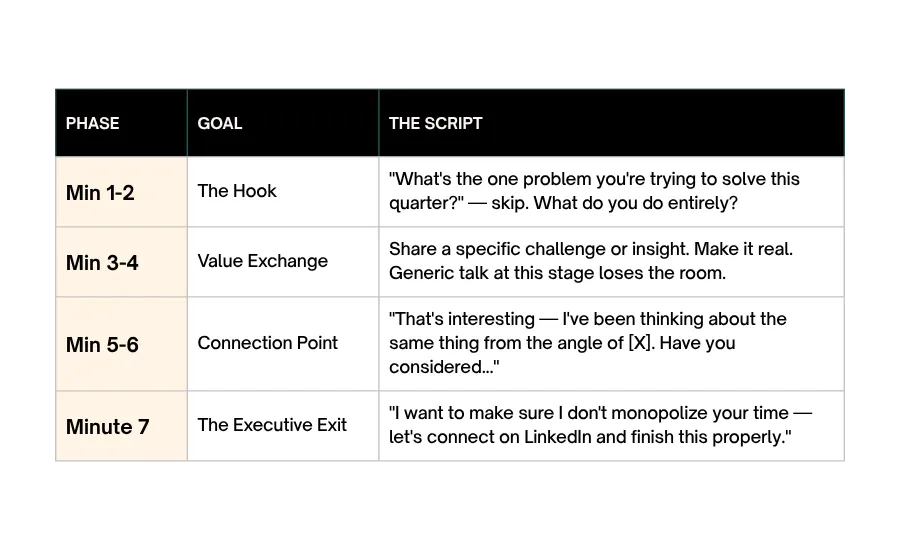
The framework works because it creates a complete conversation arc in seven minutes. Both people have contributed and both have something specific to follow up on. The exit feels natural rather than abrupt because the conversation has reached a logical conclusion point rather than just running out of things to say.
The Scripts: Exact Language for Every Phase
The most common reason this framework does not get used is the opening. "What's the one problem you're trying to solve this quarter?" feels bold if you have spent years opening with "So what do you do?".
The Hook Opener — Replace 'What Do You Do?'
THE HOOK — USE THIS INSTEAD OF 'WHAT DO YOU DO?'
"What's the one problem you're most focused on solving right now?" — or — "What brought you to this event specifically? I'm trying to figure out if I'm in the right room."
Both openers do the same thing: they bypass the resume-exchange that characterizes the first two minutes of most networking conversations and go directly to something the other person is actually thinking about. People remember the person who asked a question they had to actually think about.
The Value Exchange — How to Make Minutes 3-4 Substantive
THE VALUE EXCHANGE
"That's interesting — we ran into the same issue last year when [specific context]. What we found was [specific insight]. Have you tried approaching it from [angle]?"
The specificity is the point. Vague empathy ("yes, that's such a common challenge") keeps the conversation at the surface level. A specific reference to a real situation you have encountered moves it into the zone where professional trust begins to form.
The Executive Exit — Minute 7
THE EXECUTIVE EXIT — HOW TO LEAVE WITHOUT BEING RUDE
"I've really enjoyed this — I don't want to monopolize your time, but I'd love to continue this properly. Are you on LinkedIn? I'll send a note tonight with that resource I mentioned."
The Executive Exit solves a problem the original 7-minute rule does not address: how to actually end the conversation without it trailing into awkward silence or cutting someone off mid-sentence. The structure works because it completes three things simultaneously: it pays a genuine compliment, it respects the other person's time, and it creates a specific follow-up commitment rather than a vague "let's stay in touch."
The Introvert's Low-Energy Opener — For When You Are Already Running on Empty
LOW-ENERGY NETWORKING SCRIPT
"Honest question — what's made this event worth attending for you so far? I'm still figuring out if I'm in the right conversations."
This opener is particularly effective for introverts or for late-in-the-event moments when you have already spent significant social energy. It is disarming, it requires the other person to do the initial conversational heavy lifting, and it almost always produces a more interesting answer than any standard opening.
Executive Presence and Networking: The Layer Most Articles Skip
Networking is not just about what you say in a conversation. It is about the professional signal you project before, during, and after it. Executive presence in a networking context has specific, learnable components that determine whether people seek you out or wait for you to approach them.
How You Enter a Room
People who are consistently sought out at networking events share a behavioral pattern: they arrive early, position themselves at natural interaction points (near the food, near the entrance, near the bar), and appear unhurried. They do not check their phone while standing alone. They make brief, direct eye contact with people passing and allow conversations to start rather than forcing them. And trust me on this: This is not innate charisma. It is positioning and selective availability. Both are learnable, but you need to train.
How You Listen

The professional differentiator in any seven-minute conversation is not the quality of your talking. It is the quality of your listening. Specifically, whether you ask follow-up questions that reference something the other person actually said, or generic questions that could apply to any conversation.
Generic follow-up: "That's interesting… what do you find most challenging about that?"
Specific follow-up: "You mentioned the Q3 timeline specifically. Is that a client constraint or an internal one?"
The second question signals that you were actually listening. It is also far more likely to produce a real answer, because it requires a real response.
How You Follow Up
The follow-up is where most networking investment is lost. Standard practice is a LinkedIn connection with no message, or a generic "Great to meet you" email. Neither is memorable. The follow-up that works references something specific from the conversation within 24 hours, and either provides a resource you mentioned or asks a specific question that continues the thread.
Example: "Following up from [event] — you mentioned the challenge with distributed team communication. I came across this HBR piece this morning that addresses exactly that. Thought it might be relevant." This is not difficult. It requires only that you took a mental note during the conversation and acted on it the next day.
Digital Networking: How to Scale the 7-Minute Rule on LinkedIn
In-person networking has a hard ceiling. You can have a finite number of seven-minute conversations per event. LinkedIn removes that ceiling if you use it correctly. Most people do not.
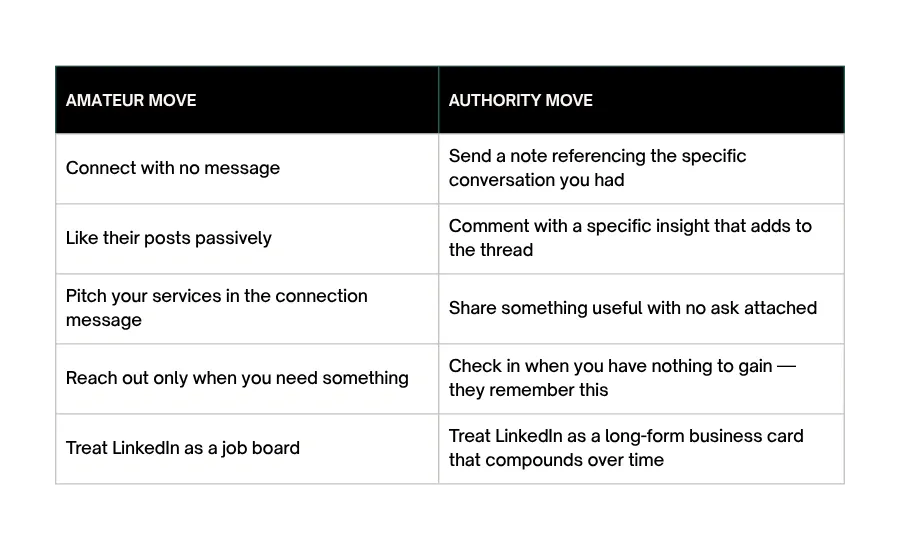
The LinkedIn strategy that compounds over time is not based on connection volume. It is based on the quality and consistency of your visible thinking. One post per week that contains a specific insight from your professional experience does more for your authority positioning than 500 passive connections. People who engage with your content have already received value from you before you have had a single conversation. That changes the dynamic in every in-person interaction that follows.
The Post-Event LinkedIn Sequence
Within 24 hours of any networking event:
- Send connection requests to everyone you had a real conversation with and include a note that references one specific thing you discussed
- Send a message to your top two or three contacts with the resource or follow-up you committed to during the conversation
- Post one observation from the event on LinkedIn, something specific you heard or thought about, not a general summary, and tag the people who were part of that conversation if relevant
This sequence takes approximately 20 minutes and produces dramatically better follow-through than the standard approach of doing nothing and hoping people remember you.
Frequently Asked Questions: Networking Strategy for Working Women
What if I'm naturally introverted and find networking exhausting?
The 7-Minute Rule is structurally better for introverts than the conventional approach. Having five real conversations is significantly less energy-draining than having twenty superficial ones. Set a target of three to five conversations per event, use the low-energy opener provided above, and give yourself explicit permission to leave once you have hit that target. Quality over quantity is not a consolation for introverts — it is the more effective strategy for everyone.
How do I apply the 7-Minute Rule in a virtual networking setting?
In virtual rooms with multiple attendees, the framework does not translate directly. The adaptation: use virtual networking events primarily to identify people worth a one-on-one follow-up call rather than trying to have meaningful conversations in a group video format. A 15-minute one-on-one video call is worth more than an hour in a virtual networking room.
What if someone clearly wants to continue the conversation past minute 7?
The 7-minute mark is a decision point, not a hard exit. If the conversation is genuinely valuable, stay. The framework is designed to prevent you from staying in low-value conversations out of politeness, not to cut off the good ones. The Executive Exit script is for conversations that have naturally peaked, not for conversations that are still building.
How do I measure whether my networking is actually working?
Not by connection count or business cards. By: how many people from networking events have referred an opportunity, introduced a contact, or reached out proactively with something relevant in the last six months. If the number is low despite consistent networking activity, the quality of conversations is the variable to address, not the frequency of events attended.
Is it worth networking in my own company, or just externally?
Internal networking is underutilized and consistently high-ROI. The people most likely to advocate for your promotion or recommend you for a high-visibility project are colleagues in other departments or at senior levels who know your work. Apply the same 7-minute framework in company events, cross-functional meetings, and informal coffee conversations.
The Room Is Not the Goal
Networking is not about the room or about the stack of cards, the LinkedIn notification count, or whether you felt comfortable at an event full of strangers. It is about the number of people who, six months from now, think of you when something relevant comes up and actually reach out.
That number is built in seven-minute increments. Focus on one real conversation at a time and one specific follow-up or one LinkedIn post that contains something worth reading. The room full of people exchanging business cards is still there; however, you do not need to compete in it on its terms.