I have spent time working from Lisbon, Tbilisi, Mexico City, and a co-working space in Chiang Mai that had better espresso than anything in an iconic neighborhood in Milan. I have also watched a lot of women romanticize the digital nomad lifestyle based on content that was accurate in 2019 and has not been updated since.
Since then, the world has changed a lot; visa infrastructure has expanded significantly, tax authorities have gotten smarter, and the question that used to be theoretical is now practical: can you actually build something real while moving around? Not just maintain a freelance income. Build a business with clients, systems, recurring revenue, and long-term growth.
The answer in 2026 is yes, with conditions. The conditions are what most digital nomad content skips entirely, which is why we are covering them here.
According to recent data, there are approximately 35 million digital nomads globally, up from 10.9 million in 2020. The Spain digital nomad visa searches are up 50% in the US in the last 24 hours, as of me writing this, which tells you exactly where interest is heading. The question is no longer whether this lifestyle is possible. It is whether you are approaching it strategically or romantically.
The Digital Nomad Landscape in 2026: What Has Actually Changed
The original digital nomad wave was driven by remote employees who quietly worked from abroad without telling their employers and freelancers who had always been location-independent. Both groups operated in a regulatory gray zone that governments have since closed, or are actively closing.
Three structural changes define the 2026 landscape:
1. Visa Infrastructure Is Real Now
As of early 2026, more than 60 countries have launched formal digital nomad visa programs. The quality varies significantly. Spain's Ley de Startups visa, Portugal's Digital Nomad Visa, Greece's Digital Nomad Visa, and Thailand's Long-Term Resident Visa are among the most frequently searched and the most functional for US-based applicants.
These are not tourist visas with a wink. They require proof of income, health insurance, and, in most cases, a clean criminal record and proof that your income source is outside the host country. The Spain visa specifically requires you to demonstrate that no more than 20% of your income comes from Spanish clients if you are applying as self-employed.
2. Tax Authorities Are Paying Attention
The 183-day rule, which determines tax residency in most countries, has been the digital nomad's unofficial framework for years. Spend fewer than 183 days anywhere, and you theoretically avoid triggering local tax residency. In practice, this is getting harder to rely on.
The IRS taxes US citizens on worldwide income regardless of where they live. The Foreign Earned Income Exclusion (FEIE) allows you to exclude up to $132,900 of foreign earned income in 2026 from US taxes, but you must meet either the Physical Presence Test (330 days outside the US in a 12-month period) or the Bona Fide Residence Test (established residency in a foreign country). Neither is automatic, and both require documentation.
If you are building a business rather than working a remote job, the tax structure is more complex. Business entity type, client location, and where you are incorporated all affect your tax exposure. This is a strong argument for getting a cross-border tax advisor before you book your first flight, not after your first year abroad.
3. Employers Have Tightened Remote Work Policies
The pandemic-era permissiveness around working from anywhere has largely ended for corporate employees. Many companies now have explicit policies about approved countries for remote work, driven by permanent establishment risk, payroll compliance, and data security concerns. If you are a remote employee considering the nomad lifestyle, your first conversation needs to be with HR, not a travel blog.
This is part of why the founder path has become more attractive. When you own the business, you make the rules about where work happens.
Digital Nomad Visa Comparison 2026: The Countries Most Searched by US Women
These are the six visa options that appear most frequently in the current US search data. Income minimums are approximate and subject to change. Always verify directly with the relevant consulate or a visa specialist before applying.
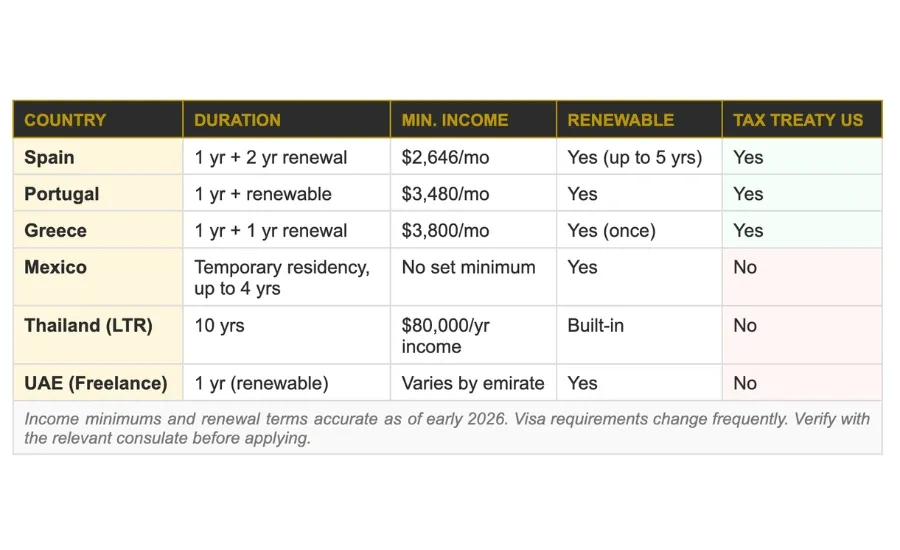
Spain remains the top-searched option, and for practical reasons: it offers a path to EU residency, has a well-developed expat and nomad infrastructure in cities like Barcelona, Valencia, and Las Palmas, and the minimum income is achievable for most established remote workers. The application process is more involved than the others on this list, but the infrastructure you gain access to justifies it.
Can a Digital Nomad Actually Build a Business? The Honest Answer
This is the question that separates the 2026 conversation from the 2019 one. The freedom narrative was always compelling. The business-building question is more interesting and more honest about what the lifestyle actually requires.
What Works
The business models that function best in a location-independent context share two characteristics: they are predominantly asynchronous, and they are not dependent on physical presence for value delivery. In 2026, this includes a wider range of work than it did five years ago.
Content and media businesses. Editorial brands, newsletters, YouTube channels, and podcast businesses operate entirely on async distribution and can be built from anywhere with reliable internet. The Working Gal itself is a model of this.
Digital product businesses. Online courses, templates, software tools, and digital assets have no shipping cost, no inventory, and no time zone dependency for the product itself. Client support requires scheduling, but the core product is location-independent.
Service businesses with retainer structures. Consulting, coaching, copywriting, design, and strategy work structured around monthly retainers rather than hourly billing reduce the coordination overhead that makes client work complicated across time zones.
E-commerce with third-party fulfillment. Businesses using Amazon FBA, Shopify with a 3PL, or print-on-demand require no physical handling of inventory and can be managed from anywhere.
What Does Not Work Well
Honesty matters here because a lot of content in this space skips it.
Agency businesses with large teams. Managing teams across multiple time zones without a fixed operational base creates compounding coordination problems. This does not mean it is impossible, but it requires deliberate systems that take time to build. Most people underestimate this.
Businesses that require in-person relationship maintenance. If your revenue depends on lunch meetings, conference presence, or local reputation, constant movement works against you rather than with you.
Businesses in the early client-acquisition phase. Building a client base from scratch while also managing logistics, visa applications, time zone coordination, and the cognitive load of being in a new place regularly is harder than it looks. Most successful nomad founders built their client base or product before they started moving.
This last point is worth sitting with. The nomad lifestyle is significantly easier to maintain on top of a business that already has revenue than it is to build from scratch while managing. If you are pre-revenue, the better sequence is usually: build first, travel second.
Nomad Employee vs. Nomad Founder: The Trade-Offs
These are not mutually exclusive paths, and many women move between them. But the trade-offs are real and worth understanding before you commit to either direction.
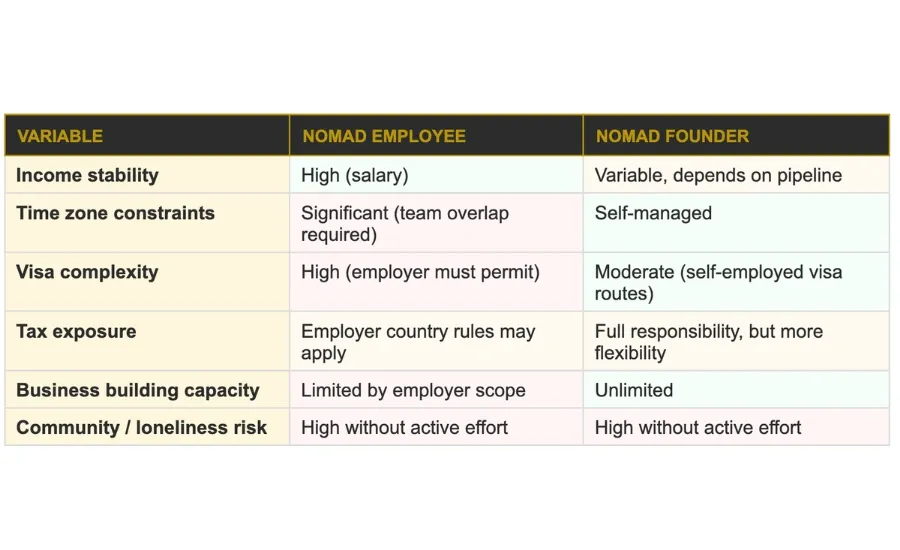
The community and loneliness risk shows up in both columns because it is the variable most people underestimate, regardless of their work structure. Digital nomadism is a fundamentally solitary lifestyle unless you actively build around it. Co-working memberships, nomad-specific communities, and recurring time in the same location rather than constant movement are the practical counters to this.
How to Build Professional Authority When You Are Not in a Fixed Office
This is the question that does not come up in travel-focused nomad content but matters enormously for anyone trying to build something serious. Authority in a professional context is built through consistency, visibility, and demonstrated expertise. All three are achievable remotely. None of them is automatic.
Online Presence as Infrastructure
For a nomad founder, your online presence is your office building. It is the place clients and collaborators go to assess whether you are credible and worth their time. A functional LinkedIn profile updated with current work, a website that clearly communicates what you do and for whom, and a content presence on at least one platform are not optional extras. They are substitutes for the physical signals of credibility that a fixed-location business provides automatically.
The content strategy that works best for nomad founders is the same one that works for any founder building authority in public: specific, consistent, and connected to demonstrated results. "I help X type of company do Y thing" communicated clearly and regularly across platforms compounds over time in the same way a physical reputation does in a fixed community.
Networking Without a Fixed Location
The professional network of a nomad founder requires more intentional maintenance than that of someone who regularly sees the same colleagues and clients. The practical approach is to be deliberate about recurring presence in specific communities, whether online, at annual conferences, or in locations you return to regularly, rather than treating every new city as a fresh networking opportunity.
People do business with people they remember. Recurring presence in a community over time produces that memory faster than a hundred introductions across a hundred cities. Learn How to Ask for What You Want at Work
Time Zone Strategy
If your clients are primarily in the US, the European nomad locations that come with the most quality-of-life benefits (Spain, Portugal, Greece, Italy) put you 6 to 9 hours ahead of East Coast clients. This is manageable if your work is predominantly asynchronous, and it requires a morning block of real-time overlap if it is not.
The nomad founders who manage this well tend to front-load their client communication in the morning local time, protect their afternoons for deep work, and are transparent with clients about their time zone from the start rather than pretending to be available in ways they are not.
Frequently Asked Questions: Digital Nomad Life in 2026
What is the best digital nomad visa for US citizens in 2026?
Spain remains the most searched and has strong infrastructure, but the application process is more demanding than in Portugal or Greece. If ease of application is the priority, Portugal's Digital Nomad Visa has a more straightforward process. If you are looking for the longest runway, Thailand's Long-Term Resident Visa offers 10 years but requires a minimum annual income of $80,000. The right choice depends on your income level, business structure, and preferred region.
Do digital nomads pay US taxes?
US citizens pay US taxes on worldwide income regardless of where they live. The Foreign Earned Income Exclusion can offset a significant portion of foreign earned income if you meet the Physical Presence or Bona Fide Residence tests, but it applies to earned income only, not passive income or capital gains. A cross-border tax advisor who works with US expats is a necessary expense if you are serious about this lifestyle, not an optional one.
What does 'digital nomad' actually mean in 2026?
The term has expanded from its original meaning of remote employee or freelancer working while traveling. It now includes a full spectrum: corporate remote employees working from approved foreign locations, freelancers on short-term contracts, founders running location-independent businesses, and hybrid nomads who maintain a home base but travel for extended periods. The common denominator is that income source and physical location are decoupled.
What are the best digital nomad jobs for women starting out?
The highest-demand remote skills in 2026 are in content creation and editorial work, UX and product design, digital marketing and paid media, software development, and online education. The most viable entry points for women building nomad income from scratch are typically freelance writing or content strategy, virtual assistance with a defined specialty, social media management, or online coaching in a professional domain where you already have expertise.
How do you avoid the loneliness problem?
Structure it out rather than hoping it resolves itself. Co-working memberships in your primary locations, participation in nomad-specific communities (Nomad List, Remote Year alumni networks, location-specific Slack groups), and deliberately building recurring presence in two or three locations per year, rather than moving constantly, all help. The women who thrive long-term in this lifestyle tend to be the ones who treat community-building with the same intentionality they bring to client development.
The Version Worth Building
The digital nomad conversation in 2026 has finally caught up to where the actual opportunity is. It was never really about the beachside laptop photos. It was about decoupling your income from a specific geography and building something that works regardless of where you are.
That is a legitimate and achievable goal. It requires better planning than most digital nomad content suggests, a clearer understanding of the tax and visa landscape than most travel blogs provide, and honesty about whether you are at the stage of building something new or maintaining something that already works.
The women doing it well in 2026 are not the ones posting the most aesthetic coffee shop content. They are the ones who did the structural work first, chose their visa situation carefully, and built the kind of business that does not require them to be in any particular room to run it.
That version is worth building.