

Most interview advice is written by people who have never hired anyone. I have sat on both sides of this conversation: as a candidate in corporate roles, freelance pitches, and agency interviews across multiple countries and industries, and as a founder who has recruited for her own company. Both perspectives changed how I think about the process, but the founder's side changed it more.
When you are the one making the hiring decision, you see something you cannot see as a candidate: the pattern. Not the individual mistake or the one nervous answer, but the recurring behavior that appears across dozens of interviews and tells you something true about how a person operates.
What follows is not a list of tips assembled from career blogs. It is the actual list of reasons I have clicked reject over the years, written the way I wish someone had told me when I was the one being interviewed. If any of these land uncomfortably, good. That means they are useful.
The 10 Reasons: Quick Reference
The full explanation of each follows below. This table is for the people who prefer to scan first.
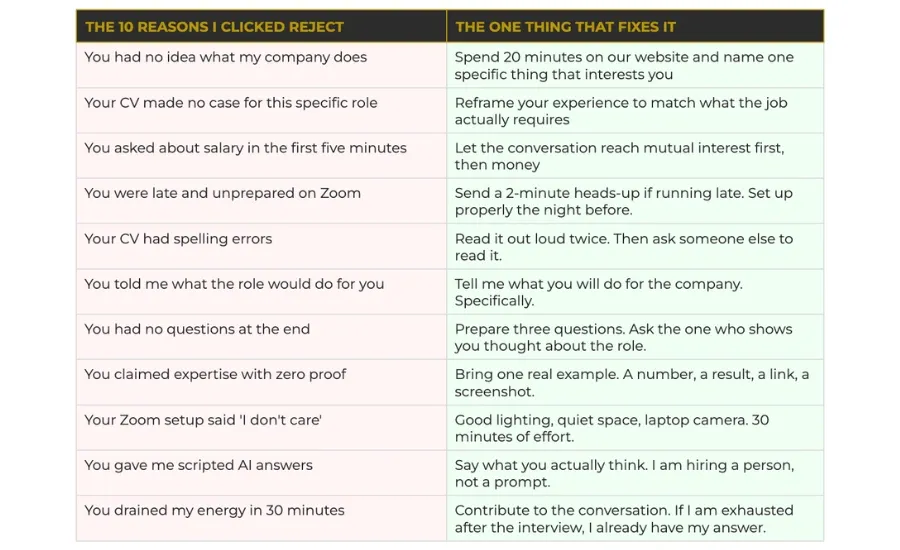
The Full List: What I Actually Think When I Click Reject
#1 You Had No Idea What My Company Does
THE PROBLEM: More than half of the candidates I have interviewed could not tell me one specific thing about the company beyond what is in the first line of the job posting. I have had people describe us based on a two-year-old description that no longer reflected what we do. I have had people who clearly confused us with another company, commenting on projects we’ve never touched. I have had people who answered 'Why do you want to work here?' with a sentence that would have applied to any company in any industry.
THE FIX: Spend 20 minutes on the website before the call. Read the About page, look at recent content or work, find one specific thing that genuinely interests you, and mention it. This alone puts you in a different category from the majority of candidates, which is a low bar that most people still do not clear.
#2 Your CV Made No Case for This Specific Role
THE PROBLEM: Sending a completely generic CV to a specific job posting is a signal that you are applying at volume and hoping something sticks. I understand the job market is difficult. I have been in it. But a CV that has not been adapted to the role tells me before we have even spoken that this particular opportunity is not something you considered seriously enough to spend 30 minutes on. The bar here is not perfection. It is relevance. If you are applying for an account manager role and your most recent experience is in hospitality, you have transferable skills in client relationships, communication, and managing expectations under pressure. Those are directly applicable. Make that case explicitly. I cannot make it for you.
THE FIX: Read the job description carefully and identify the three skills or experiences it values most. Then look at your CV and make sure those three things are visible and clearly framed. You do not need to fabricate experience. You need to translate the experience you have into language that connects to what the role requires.
#3 You Asked About Salary in the First Five Minutes
THE PROBLEM: Compensation is a legitimate part of any job conversation, and there is nothing wrong with asking about it. The timing is the problem. Walking into an interview and asking about the salary before we have established whether there is mutual interest signals that the only variable you are evaluating is money, which makes the rest of the conversation feel like a formality. It also puts the conversation in a transactional frame before either of us knows whether the role is even a fit.
THE FIX: Let the interview develop. Ask your compensation question toward the end of the first conversation, or when the interviewer opens that part of the discussion. If the salary range was not included in the job posting and it is a dealbreaker for you, you can raise it professionally at the end: 'Before we go further, I want to make sure we are aligned on the compensation range so neither of us invests more time if there is a significant gap.' That is direct and reasonable. First-minute salary questions are neither.
#4 You Were Late, Unprepared, and Your Zoom Setup Looked Like an Afterthought
THE PROBLEM: I once interviewed a candidate who joined a video call eight minutes late, did not apologize, conducted the interview from their phone propped against something, had audible background noise throughout, and looked at something off-camera repeatedly while I was speaking. This is a single example, but versions of it are not rare. Bad lighting, a cluttered or distracting background, dogs, washing machines, street noise, a phone camera instead of a laptop. Every single one of these says the same thing: I did not prepare for this conversation. If you cannot manage the setup for a 30-minute professional call, I am not going to be confident about how you will manage the setup for a client meeting.
THE FIX: Set up the night before, not five minutes before the call. Laptop camera, not phone. Find a quiet space with decent light facing you, not behind you. If something genuinely comes up and you will be late, send a quick message. Two sentences are enough. The message itself is not the point. The point is that it demonstrates you understand that the other person's time has value.
#5 Your CV Had Spelling Errors
THE PROBLEM: This is not a perfectionism issue. It is an attention-to-detail issue. Your CV is the one document in this entire process that you have unlimited time to prepare, review, and correct. It is also the first thing I see before I form any other impression. A spelling error in a CV tells me that the standard of work I can expect from you is one where obvious mistakes get through because checking carefully is not a habit. That is a problem in almost any professional context, and it is a significant problem in client-facing roles.
THE FIX: Read your CV out loud, slowly, from the bottom up. Then give it to one other person to read. The reason the out-loud method works is that your brain autocorrects when you read silently because it knows what you meant to write. Reading out loud forces it to process what is actually there.
#6 You Told Me What the Role Would Do for You Instead of What You Would Do for the Company
THE PROBLEM: When I ask 'Why do you want to work here?' and the entire answer is about what you will learn, how you want to grow, why you like remote work, or what the company's culture offers you, I hear: I am thinking about this entirely from my own perspective. Growth and learning are not irrelevant. But they are not what I am asking. I am asking what made you think this company and this role specifically are worth your time. The answer I want to hear has something to do with the work we do, the problems we solve, the direction we are going. Not what working here will give you. Unless you are applying for an intern position.
THE FIX: Prepare a two-sentence answer to this question that names something specific about the company and connects it to something you can contribute. 'I have been following your work on X, and I think my background in Y is directly relevant to where you are taking it' is infinitely stronger than any version of 'I want to learn and grow in a dynamic environment.'
#7 You Had No Questions at the End
THE PROBLEM: When I reach the end of an interview and ask 'Do you have any questions for me?' and the answer is 'No, I think we covered everything' or 'Not really,' I make a specific inference: this person did not think critically about this role or this company beyond what they needed to get through the interview. An interview is supposed to be a two-way evaluation. You are assessing whether this is the right environment for your work as much as I am assessing whether you are the right person for the role. If you have genuinely no questions, that is a signal that either you do not care enough to be curious or you have not thought about it at all.
THE FIX: Prepare three questions. Ask the one that feels most genuine. Good examples: 'How do you measure success in this role after six months?' 'What does the team dynamic look like day to day?' 'What is the most significant challenge the person in this role will face in the first 90 days?' All three show that you are thinking about the work, not just the offer.
#8 You Claimed Expertise With Zero Proof
THE PROBLEM: This is the one that comes up most often in roles that require demonstrable skills: marketing, content, design, development, social media, SEO. Someone says they are a social media expert (please don’t say that anymore). I ask which accounts they have grown and by how much. They name an account with 400 followers. Someone says they have done SEO. I ask to see a Search Console screenshot or a before-and-after result. They do not have one. Claims without evidence are just words. In a professional context where the output of the role is the work itself, words are not enough.
THE FIX: Bring proof to every interview for a skills-based role. A portfolio link, a results screenshot, a case study, a live example. If you do not have polished portfolio pieces, show the work anyway and explain the context. One real result with numbers is worth more than a perfect-looking portfolio of vague projects. If you genuinely have no proof yet, say so directly and explain what you are building. Honesty about where you are is more compelling than overclaiming.
#9 You Gave Me Scripted AI Answers
THE PROBLEM: This is the 2026 version of the problem that used to be called 'over-rehearsed.' The tell is different now: the answers are grammatically perfect, structurally sound, and completely hollow. When I ask 'Tell me about a time you handled a challenging client situation' and the response sounds like it was generated by a prompt that started with 'Write a professional answer to a common interview question,' I am not learning anything about you. I am learning that you prepared a script. The worst version is when the answer does not quite match the specific question I asked, because it was written for a slightly different version of the question, and you did not adjust it in real time.

THE FIX: Use preparation to get clear on your real experiences, not to write answers in advance. Know which three work stories you want to draw from. Know what they demonstrate. Then let the actual conversation guide how you tell them. Interviewers are looking for the person behind the answer. The script hides the person.
#10 You Were an Energy Drain
THE PROBLEM: This one is harder to name but very easy to feel. Candidates who answer in monosyllables, who wait for the next question without contributing anything the question did not directly ask for, who convey through their energy that this conversation is something to get through rather than something to engage with. If I leave the interview feeling tired from carrying the conversation, that is information. I manage enough cognitive load in running a company. I am not going to add to it by hiring someone who requires me to pull every piece of information out of them in daily work.
THE FIX: An interview is a conversation, not a deposition. Contribute to it. If a question makes you think of something relevant that the question did not directly ask, say it. Ask a follow-up. Show some genuine reaction to what is being discussed. Energy in a 30-minute interview is a preview of energy in day-to-day work. Make it a good preview.
The Follow-Up: The Move That Separates Most Candidates From the Rest
Most candidates do not send a follow-up message after an interview. Of those who do, most send a template: 'Thank you for your time, I enjoyed learning about the role, I look forward to hearing from you.' This is not a follow-up.
A real follow-up references one specific thing from the conversation, adds something to it, and is sent within 24 hours. Example: 'Thank you for the conversation today. You mentioned that the team is expanding the content strategy into video this quarter. I worked on a similar transition at my last role and ran into the same challenge you described around consistency of output. Happy to share what worked if it would be useful.'
That message does three things: it proves you were paying attention, it demonstrates relevant experience in context, and it gives me a reason to continue the conversation beyond a standard decision timeline. It is also a piece of writing I can evaluate. In a role where communication quality matters, a well-written follow-up is itself a work sample.
A bad follow-up is worse than no follow-up. An over-eager message sent 10 minutes after the call, a template that misspells my name, or a follow-up that asks whether I have made a decision after 48 hours are all signals I note. The follow-up is the last impression you leave before I decide. Make it a good one.
The Part You Are Allowed to Forget: Interviewing the Company Back
Everything above is written from the recruiter's side. Here is the candidate's side, because I have been there too, and the advice I wish I had been given earlier is this: you are allowed to treat the interview as a two-way evaluation from the start, not just after you have the offer.
The questions that actually tell you something about a company:
'How do you measure success for this role in the first 90 days?' A vague answer means they have not thought about it, which tells you something about how the role is managed.
'What is the thing that most often derails good people in this role?' An honest answer to this is more useful than any amount of employer branding.
'What does the feedback loop look like here? How do people know how they are doing?' This tells you how the company handles performance, growth, and difficult conversations.
'What has changed in this team or this role in the past year?' This tells you whether the company is evolving, stagnating, or in the middle of something you need to understand before you join.
A company that is irritated by specific, intelligent questions is showing you something important before you have committed to anything.
Frequently Asked Questions
Is it always a red flag to ask about salary early?
No. If the job posting did not include a salary range, and it is information you genuinely need to decide whether to proceed, asking for it at the end of an initial screening call is reasonable and professional. The version I described as a red flag is asking in the opening minutes of a substantive interview before any mutual interest has been established. Timing and framing are the variables.
What if I genuinely do not have a portfolio yet?
Say so, and say what you are building instead. 'I am building my portfolio now and can share examples from a project I am currently working on' is honest and shows initiative. What I am actually evaluating in this area is proof that the skill exists, not necessarily a polished professional portfolio. A personal project, a volunteer role, or a side effort that demonstrates the capability is sufficient. What is not sufficient is claiming expertise you cannot demonstrate in any form.
How long should a follow-up message be?
Three to five sentences. Long enough to be specific, short enough to be read in 30 seconds. No bullet points, no headers. A follow-up email is a professional note, not a proposal.
What if I am genuinely nervous and it affects how I present?
Nerves are not a red flag. The behaviors I described above are patterns, not symptoms of anxiety. A nervous candidate who is clearly prepared, engaged, and genuinely thinking about the answers to questions is a very different interview from a disengaged candidate who performs composure. I have hired nervous people. I have not hired people who were simply not present.
Yes, I Am Demanding. Here Is Why That Is Useful Information.
Everything on this list is fixable before the next interview. None of it requires a different personality, a different background, or a different level of experience. It requires preparation, attention, and enough respect for the other person's time to show up having thought about the conversation in advance.
I am demanding in interviews because I am demanding about the work, and the interview is the preview. The candidates who get offers are not always the most qualified on paper. They are the ones who made the process feel easy: they did their research, they were clear about what they bring, they asked something worth asking, and they made me feel like hiring them would reduce my workload rather than add to it.
That is the job. And it starts before you open Zoom.