
The brilliant consumer mechanics of turning a $16 cream blush into this season’s most coveted fashion accessory.
On September 15, Rhode released its latest limited-edition drop: the "Pocket Pearl," a shimmery miniature iteration of its Pocket Blush co-created with Alexandra Leclerc.
The collection arrives in three deliberate shades—Gemini, Monet, and Monaco—alongside an apple-infused peptide tint. Yet the true strategic centerpiece of the launch has nothing to do with pigment dispersion or barrier restoration.
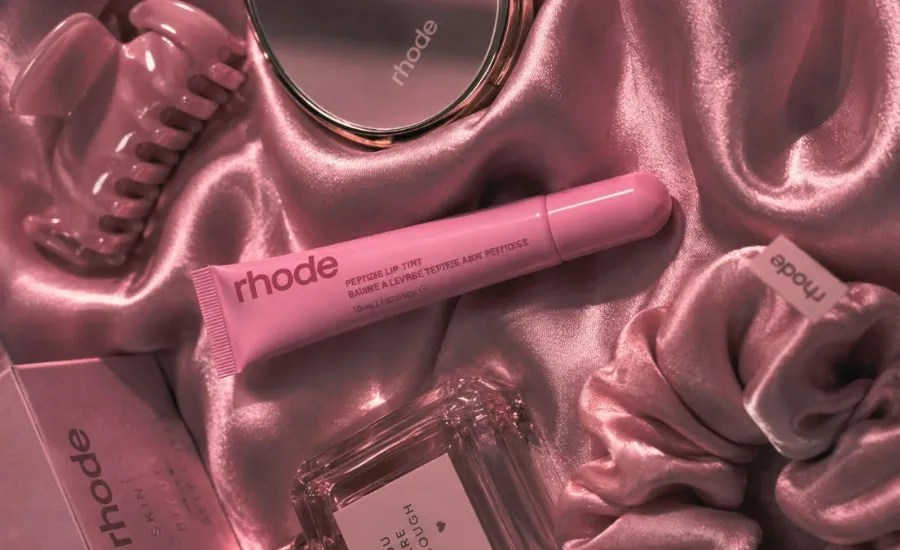
It is an eight-dollar butterfly charm and a branded carabiner designed to clip the blush directly onto the strap of a designer tote.
With that single piece of hardware, Hailey Bieber’s team demonstrated why Rhode consistently outmaneuvers heritage beauty conglomerates with ten times its R&D budget. Rhode is no longer operating under the traditional rules of the cosmetics counter. It has quietly executed a masterclass in consumer packaged goods: transitioning from a skincare brand into an everyday carry hardware label.
Solving the Vanity Dilemma
Historically, prestige beauty products were designed for private, domestic spaces.
Creams sat on marble vanity trays; lipsticks lived inside zipped interior pockets of leather bags. You applied them in restrooms or private moments. The luxury lived entirely in personal tactile satisfaction: heavy fluted glass, magnetic closures, and formulation performance. The problem for modern beauty marketing is simple: products kept inside a bag generate zero public impressions.
Rhode reversed that spatial dynamic with tactical precision.
First came the viral silicone iPhone case, which converted a sixteen-dollar lip treatment into an unavoidable billboard every time a user took a mirror selfie. The Pocket Pearl carabiner solves the identical exposure problem for the handbag market. By designing hardware that allows consumers to fasten a cosmetic pod to a belt loop, a gym duffel, or a luxury handle, Rhode turned its customer base into active, walking brand ambassadors.
You do not simply use Rhode; you display it.
When a young woman clips that branded capsule to her bag, she isn’t declaring her allegiance to micro-fine shimmer. She is signaling membership in a very specific, aspirational aesthetic universe: Monaco paddocks, European summer travel, and clean-line minimalism.
The Supreme Blueprint Applied to Beauty
Legacy beauty brands like Estée Lauder or L’Oréal prioritize permanent shelf space across global department stores. Their operational goal is continuous volume, which inevitably creates surplus inventory, discounting, and promotional fatigue.
Rhode operates on the streetwear drop architecture:
Engineered Scarcity: Produce limited runs, create artificial allocation windows, and trigger immediate digital queues.
Cultural Context over Chemistry: Anchor the drop to a curated lifestyle partner—in this case, Leclerc’s high-visibility Formula One social orbit—to justify the purchase as cultural participation rather than a toiletry refill.
Micro-Sizing for Margin: Offering a miniature 0.08-ounce format at sixteen dollars yields an extraordinary price-per-ounce margin that rivals top-tier couture houses, all while keeping the entry barrier low enough for an impulse checkout.
The genius of the strategy is its speed. By the time consumer watchdog accounts begin debating whether the shimmer formula offers anything genuinely unique over existing cream sticks, the production run has completely sold out and the marketing engine has pivoted to teasing the next seasonal drop.
The New Rules of Brand Building
Critiquing Rhode based on formulation chemistry misses the larger commercial picture.
Bieber’s company didn't rise because it discovered a proprietary anti-aging peptide. It dominates because its leadership recognized that modern beauty consumers don't buy products purely for clinical efficacy—they buy them as portable status symbols and tactile lifestyle props.
Rhode isn't just competing with Glossier, Merit, or Summer Fridays. It is competing for the same real estate as designer keychains, luxury bag charms, and tech accessories.
Whether you buy the blush on or roll your eyes at the carabiner, the operational takeaway is undeniable: turning an ordinary cosmetic into a visible daily accessory is the sharpest retail maneuver beauty has seen in a decade.