When stress spikes in the middle of a relentless workweek, standard relaxation advice usually misses the mark. Telling an overwhelmed mind to simply "calm down" or meditate rarely works when adrenaline and cortisol are actively flooding your bloodstream.
Stress is not merely a mental state; it is a physiological event. Prolonged mental strain manifests as chronic physical guarding: shoulders hitched toward ears, restricted shallow breathing, clenched pelvic floors, and a sympathetic nervous system locked in permanent fight-or-flight mode.
To disrupt that biological stress loop quickly, you have to bypass the mind and communicate directly with the body.
Restorative yoga works because it leverages somatic mechanics. Gentle spinal articulation, prolonged supported folds, and mild inversions trigger mechanoreceptors and stimulate the vagus nerve, signaling your autonomic nervous system to initiate the parasympathetic "rest-and-digest" response.
You do not need a 60-minute studio class or advanced flexibility to shift your baseline. Here are five foundational, restorative poses engineered to release muscular tension and down-regulate your nervous system in ten minutes.
Child's Pose (Balasana)
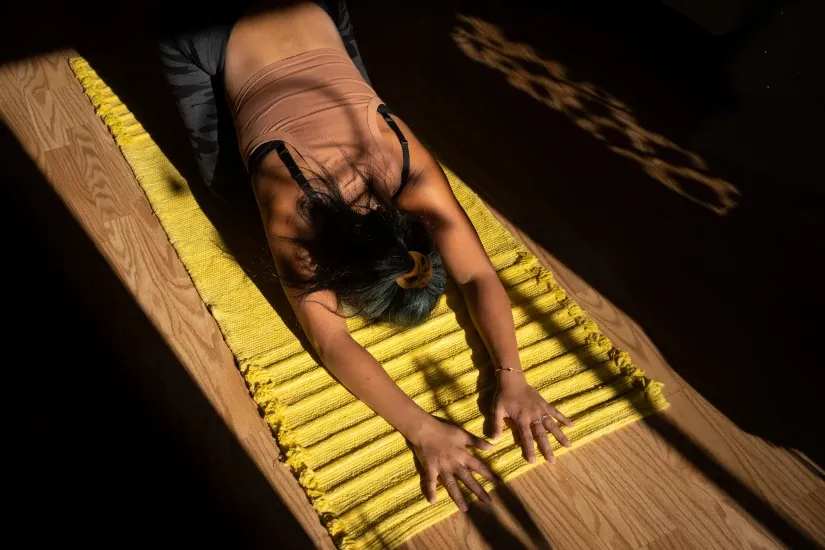
Child’s pose is a somatic reset button. By folding the torso over the thighs and resting the forehead directly against the mat or a firm cushion, you instantly limit external visual stimulation and encourage deep diaphragmatic expansion into the posterior ribs.
The light compression against the front body stimulates the vagus nerve, which runs through the abdomen and chest, slowing elevated heart rates and down-regulating acute anxiety.
How to execute: Kneel on a soft surface, touch your big toes together, and separate your knees wider than hip-width apart. Sink your hips firmly back onto your heels, fold forward from the hips, and drape your torso between your thighs. Rest your forehead flat against the floor. Extend your arms out in front with palms grounded, or sweep them alongside your legs with palms facing up to completely release tension across the trapezius muscles. Hold for two to three minutes, focusing on expanding the back of your lungs with every inhale.
Cat-Cow Pose (Marjaryasana-Bitilasana)
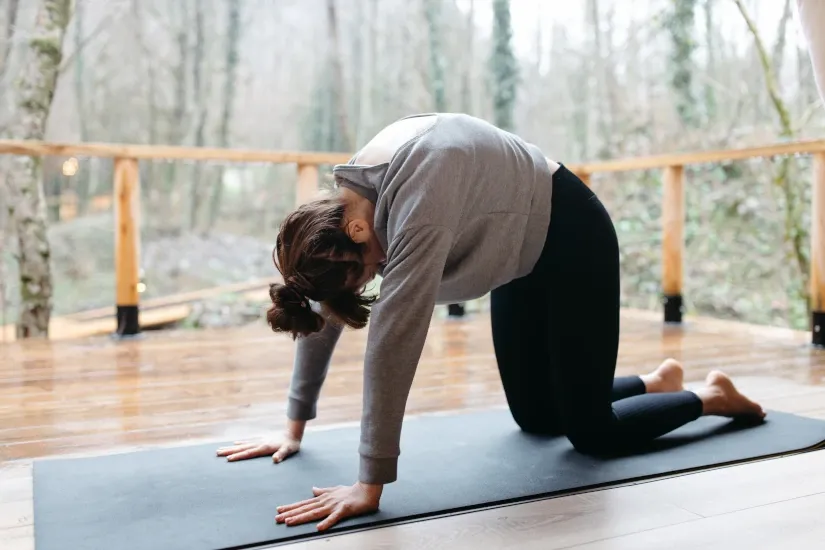
When seated at a desk for hours, the thoracic spine stiffens, and breathing patterns become shallow, reinforcing physical tension throughout the torso. Cat-Cow pairs rhythmic spinal articulation with conscious breath, mobilizing cerebrospinal fluid and releasing postural rigidity along the paraspinal muscles.
How to execute: Begin on all fours with wrists stacked directly beneath shoulders and knees aligned under hips. On a deep inhalation, transition into Cow Pose: lower your belly toward the mat, gently draw your shoulder blades down your back, and lift your chest and tailbone upward. On the exhalation, move into Cat Pose: press firmly through your palms, round your entire spine toward the ceiling, tuck your tailbone, and let your head release naturally toward your chest. Move smoothly between the two shapes for eight to ten breath cycles, letting your breath initiate every movement.
Downward-Facing Dog (Adho Mukha Svanasana)
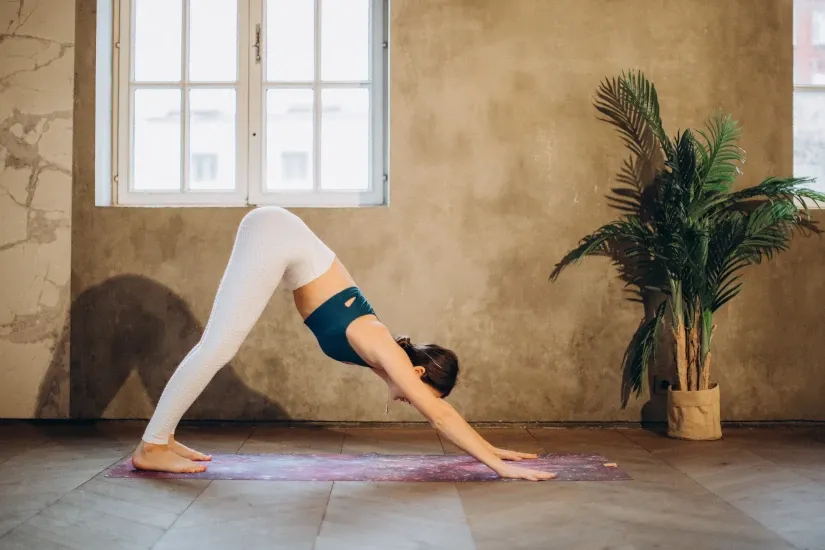
Downward-Facing Dog functions as a gentle inversion, placing the heart above the head without the instability or pressure of advanced headstands. This inverted position stimulates baroreceptors in the neck and upper chest, signaling your central nervous system to lower blood pressure and slow systemic tension.
Simultaneously, the pose decompresses the cervical spine and provides a continuous eccentric stretch across the entire posterior chain, from the hamstrings and calves to the lower back.
How to execute: From tabletop, spread your fingers wide, tuck your toes, and press firmly through your index knuckles as you send your hips up and back. Prioritize a long, straight spine over straight legs; keep a generous bend in your knees if your hamstrings feel tight. Press the ground away to create space between your shoulders and ears. Hold for five slow, steady breaths, exhaling fully through the nose.
Legs Up the Wall (Viparita Karani)
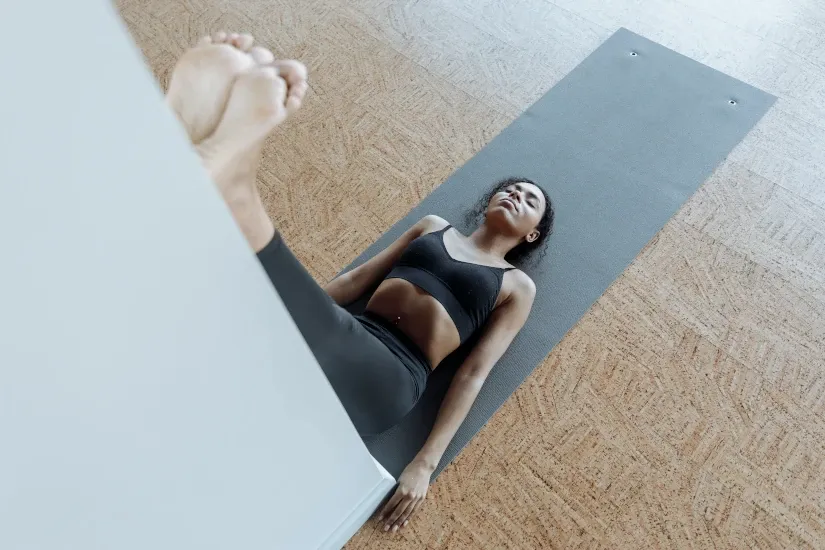
If you only have five minutes at the end of an exhausting day, make it this pose. Viparita Karani is one of the most effective restorative postures in modern somatic therapy.
By elevating the legs above the level of the pelvis and heart, gravity naturally assists venous return and accelerates lymphatic drainage from swollen lower extremities. The passive elevation removes pressure from the cardiovascular system, prompting immediate parasympathetic activation and lower resting cortisol levels.
How to execute: Sit sideways against a clear wall with your hip touching the baseboard. In one fluid movement, swing your legs up along the wall as you recline your back flat onto the floor, bringing your seat as close to the wall as comfortably possible. Let your arms rest outward in a soft "V" shape with palms facing the ceiling to open the chest. Close your eyes, release any effort in the legs, and remain here for five to ten minutes.
Supported Corpse Pose (Savasana)
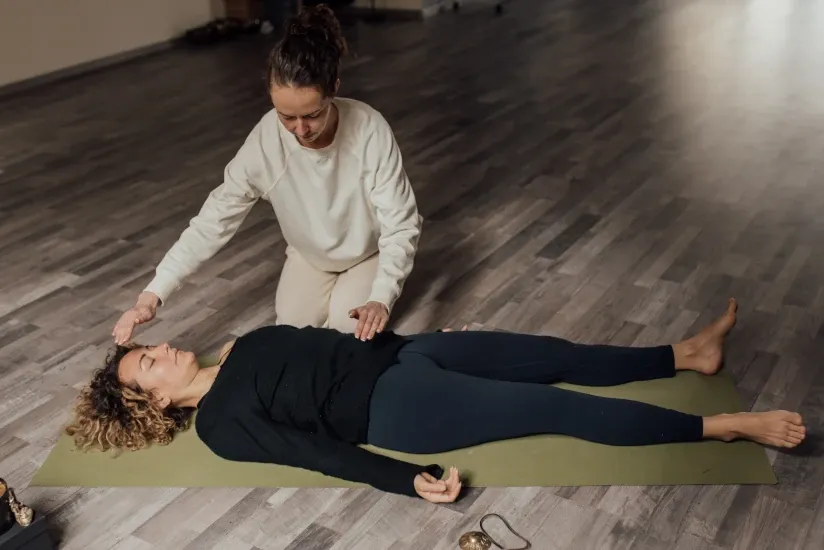
Corpse pose is frequently misunderstood as simply lying down, but neurologically, it is the most critical component of physical stress release. It provides a structured sensory pause where the body integrates the muscular release of previous movements and recalibrates muscular tone.
Without conscious stillness, the body rarely registers that an acute stressor has passed. Savasana provides that non-negotiable physiological closing bracket.
How to execute: Recline flat on your back. To protect your lower back from tight hip flexors, place a rolled blanket or bolster beneath your knees. Allow your feet to fall naturally open to the sides. Extend your arms comfortably away from your sides with palms turned upward. Unclench your jaw, smooth the space between your eyebrows, and allow your natural breathing rhythm to take over without trying to control it. Stay completely still for five uninterrupted minutes.
Integrating Movement into High-Stress Days
Physical decompression does not require rigid scheduling or perfectionist routines.
When afternoon fatigue sets in or cognitive burnout peaks, stepping away from screens for a single five-minute pose shifts your physiology out of emergency mode. Prioritize slow, controlled exhalations over deep forced inhales, listen to what your body is holding, and use gentle movement as practical somatic maintenance throughout your week.